
Launch leadership
Fuse 1+ 30W
Engineering sign-off across a 30+ engineer redesign, 130+ ECOs, EVT/DVT/PVT, factory acceptance, and production release.
9 mo. launch55%+ SLS share
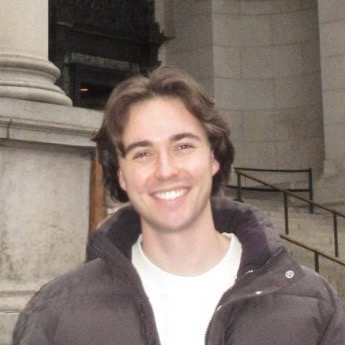
I build and architect industrial powder-bed additive manufacturing systems from first principles and lead multidisciplinary teams from process R&D through production. At Formlabs, I held engineering sign-off for the Fuse 1+ 30W launch and led early Fuse X1 optical and thermal architecture. At Georgia Tech, I invented a new polymer powder-bed process and built its machine, RF heating network, and multiphysics design software.
A decade building additive manufacturing processes, machines, software, and teams.
Engineering sign-off across a 30+ engineer redesign, 130+ ECOs, EVT/DVT/PVT, factory acceptance, and production release.

Led early optical and thermal architecture, reducing a broad process and hardware search space to a few characterized system options.
Invented a polymer powder-bed process, secured approximately $150K, and built the custom motion, jetting, controls, instrumentation, safety, and RF systems. Hand-built matching network; first parts fused October 2026.

Built a finite-difference-verified direct/adjoint pipeline that converts geometry into filtered, quantized, printer-ready dopant maps.

Peer-reviewed WAAM and hybrid WAAM/powder-blown DED research, including a 2025 paper in npj Advanced Manufacturing.

SLS Systems R&D & Technical Program Leadership

A new polymer powder-bed process, custom machine, RF heating system, and coupled computational design platform
Coupled 2.5D/3D process simulation and finite-difference-verified adjoint design of printer-ready material maps
Explore Tool →
$100 flatbed scanner + open-source Python toolkit for jetting diagnostics and ink concentration analysis
Learn More →
A ridiculously over-engineered automatic bottle opener built in college—featured on Hackaday article and podcast
Watch the Video →
An interactive installation where guests peer through an interdimensional portal to view AI-generated alternate realities of Georgia Tech
View Installation →
A mobile app helping seniors plan weekly activities to stay active, mobile, and socially connected
Try the Prototype →Want to check out my older work? Explore my undergraduate projects, leadership roles, and early industry experience from 2017-2021.


10+ years studying and performing jazz. Lead alto in NIU Jazz Orchestra. Music taught me to listen, collaborate, and improvise—skills that translate directly to engineering.
I'm always open to discussing additive manufacturing, research collaborations, or industry opportunities.
Selective Laser Sintering R&D • Somerville, MA
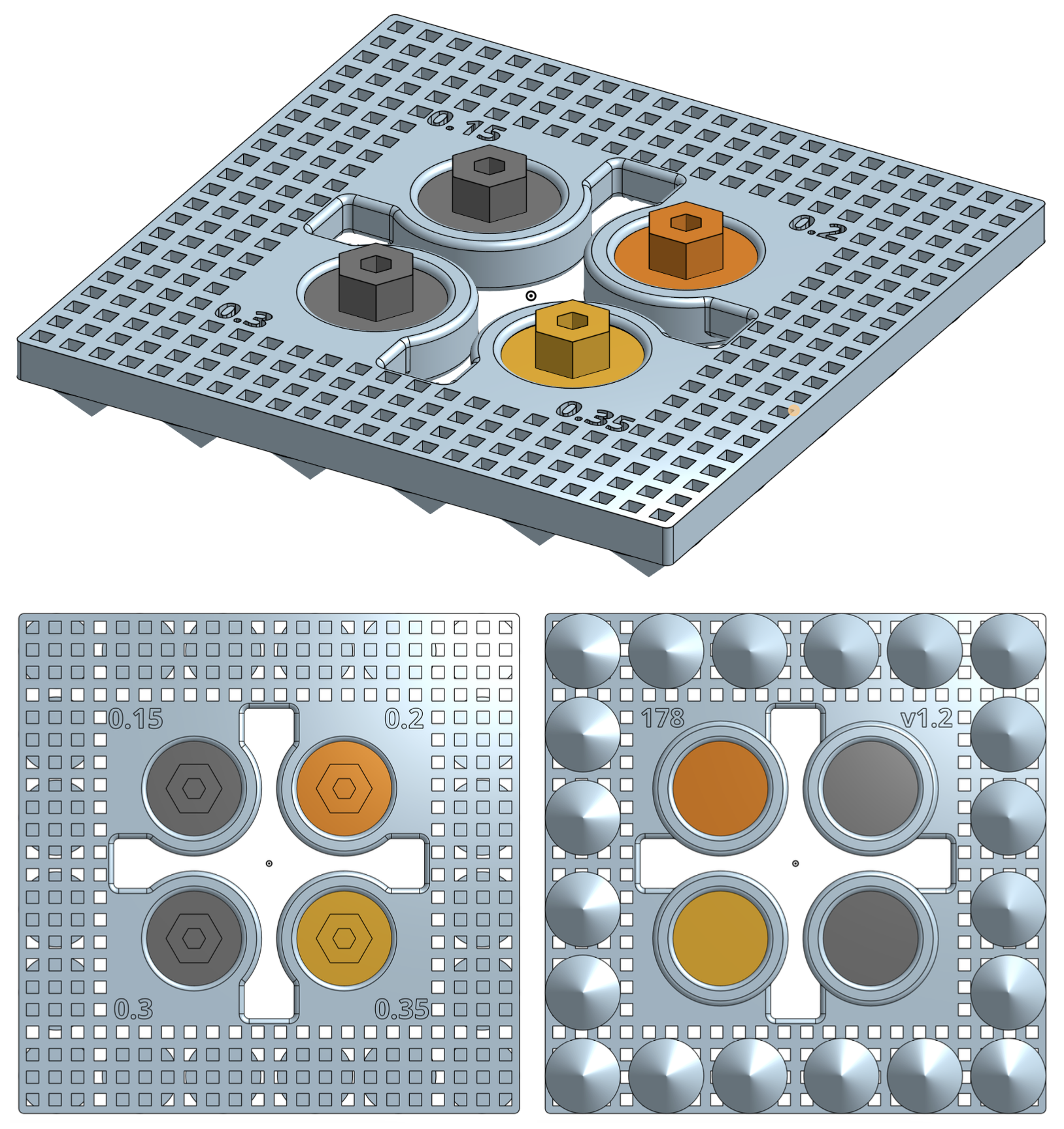
At Formlabs, I grew from Fuse SLS process and hardware development into printer-wide technical ownership. I led engineering execution and sign-off for the 30+ engineer Fuse 1+ 30W launch, then returned to deep R&D to lead early optical and thermal architecture for Fuse X1. My work spanned materials, process physics, hardware, controls, calibration, factory software, and customer tools—including the bed-temperature tool used by Adam Savage.
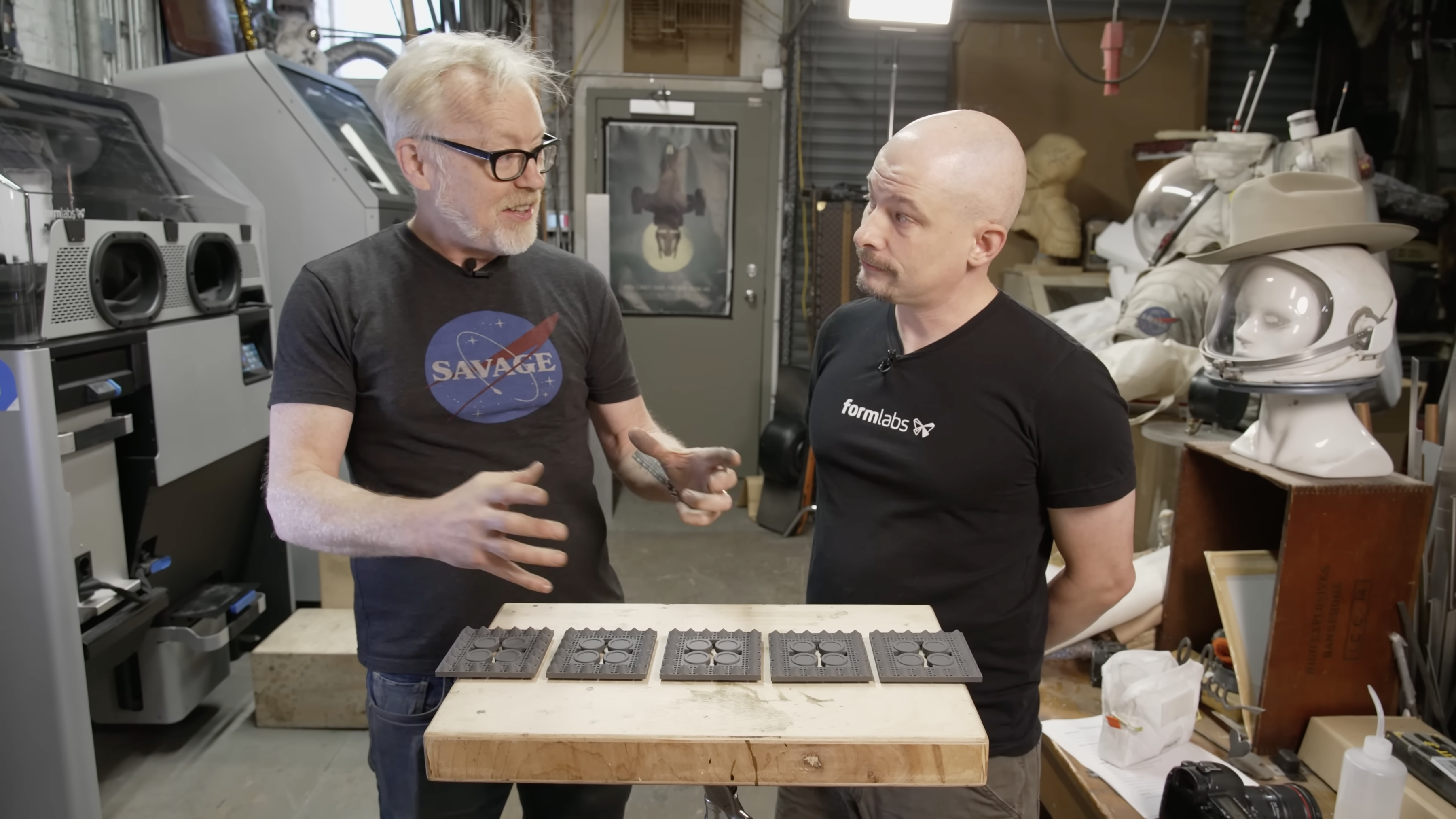
My most widely deployed tool—used by customers, field engineers, and makers like Adam Savage. Diagnostic part with torque spinners, dimpling grids, and birchbark cones for visual/mechanical assessment of thermal uniformity.
 Diagnostic Tool
 Adam Savage's Setup
Left: Adam Savage's Fuse 1+ 30W (tool at 7:42) • Right: Official Formlabs tutorial
Despite its "plus" naming, the Fuse 1+ 30W was a complete rebuild of Formlabs' SLS platform—new optical systems, thermal systems, material handling, PCBAs, electronics, and software. I served as Technical Program Manager from EVT through production launch, coordinating 30+ engineers across 130+ ECOs to deliver the program in just 9 months—the fastest full printer launch in Formlabs history.
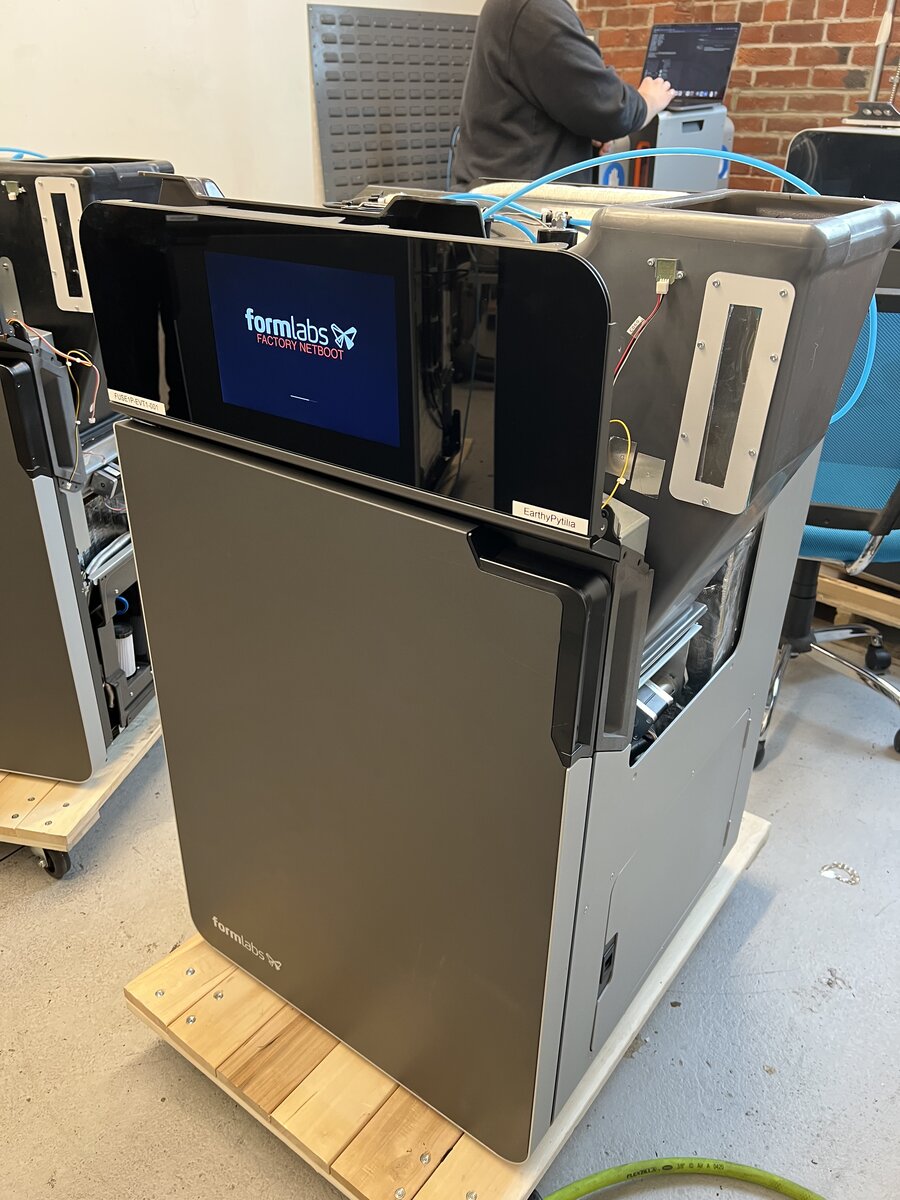 EVT Bringup
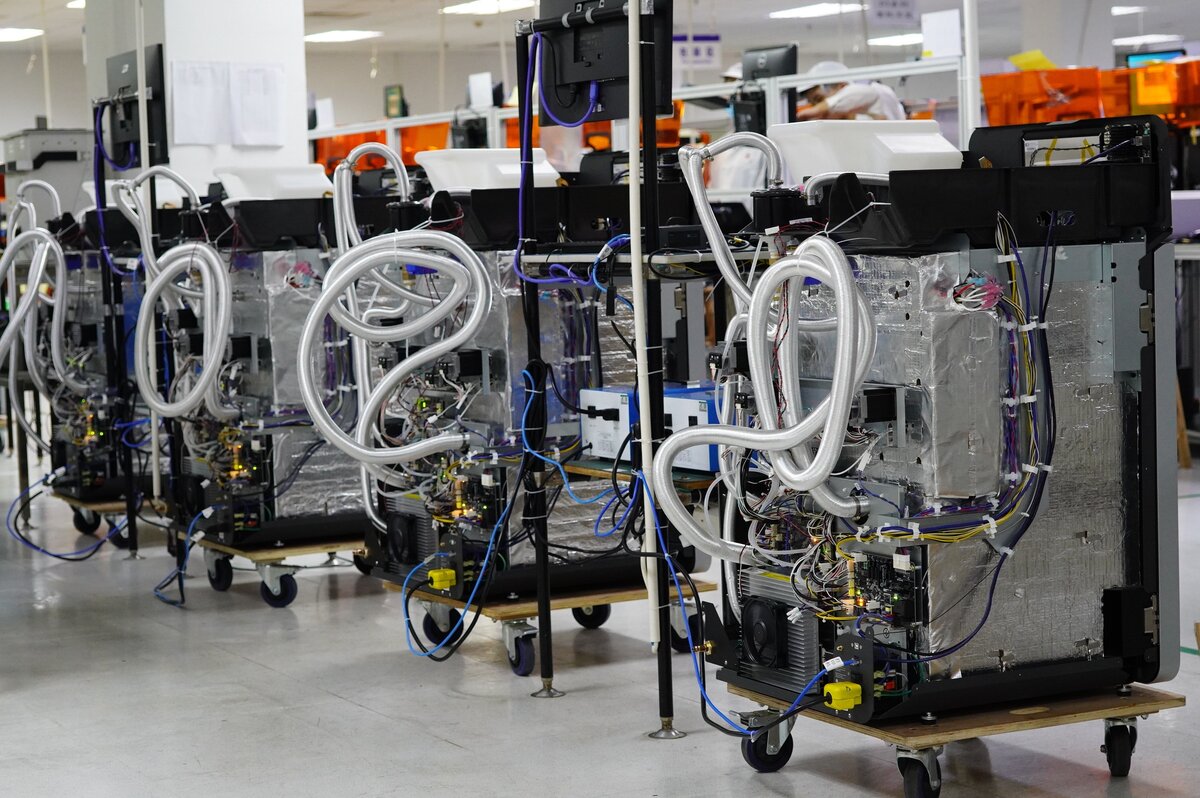 DVT Bringup
Program leadership:
Factory & production:
Impact:
Additional research enabling data-driven decisions for next-generation SLS development:
LEGO approached us with a challenge: if we could achieve sub-100μm tolerance, they would equip their facilities with multiple Fuse printers. I developed a per-printer calibration tool using Gage R&R methodology and Outer Boundary Offset correction for thermal bleed, improving factory standard performance by 3x to achieve ±100μm tolerance. This enabled LEGO to deploy Fuse printers in their production lines—not just for jigs and fixtures, but for end-use pieces as well.
Documentation →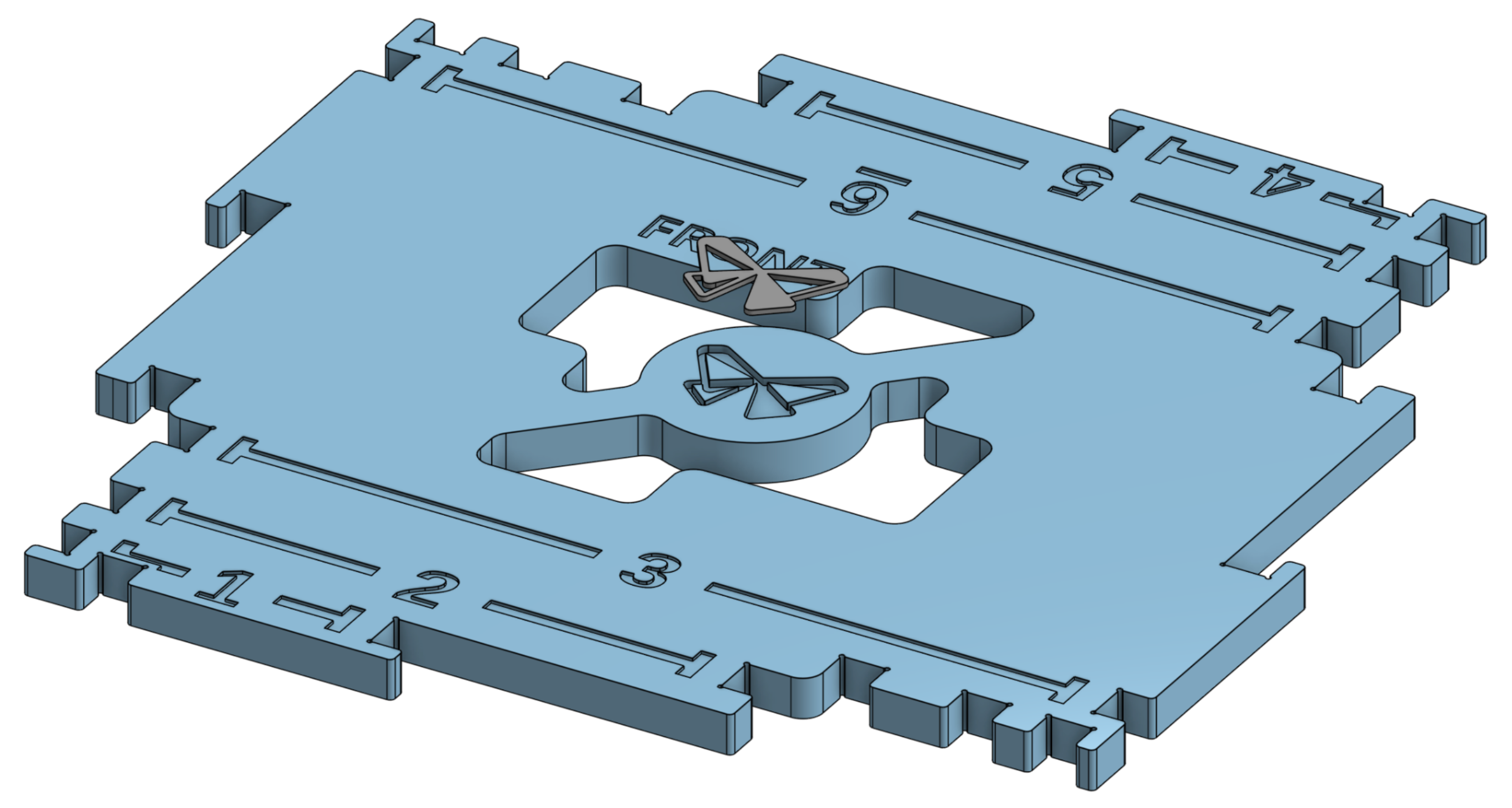
Increased print speed 30% via thermal optimization. Achieved 33% interlayer time improvement, yielding approximately 4 hours of free build time per print job.
Print speed comparison: before and after thermal optimization
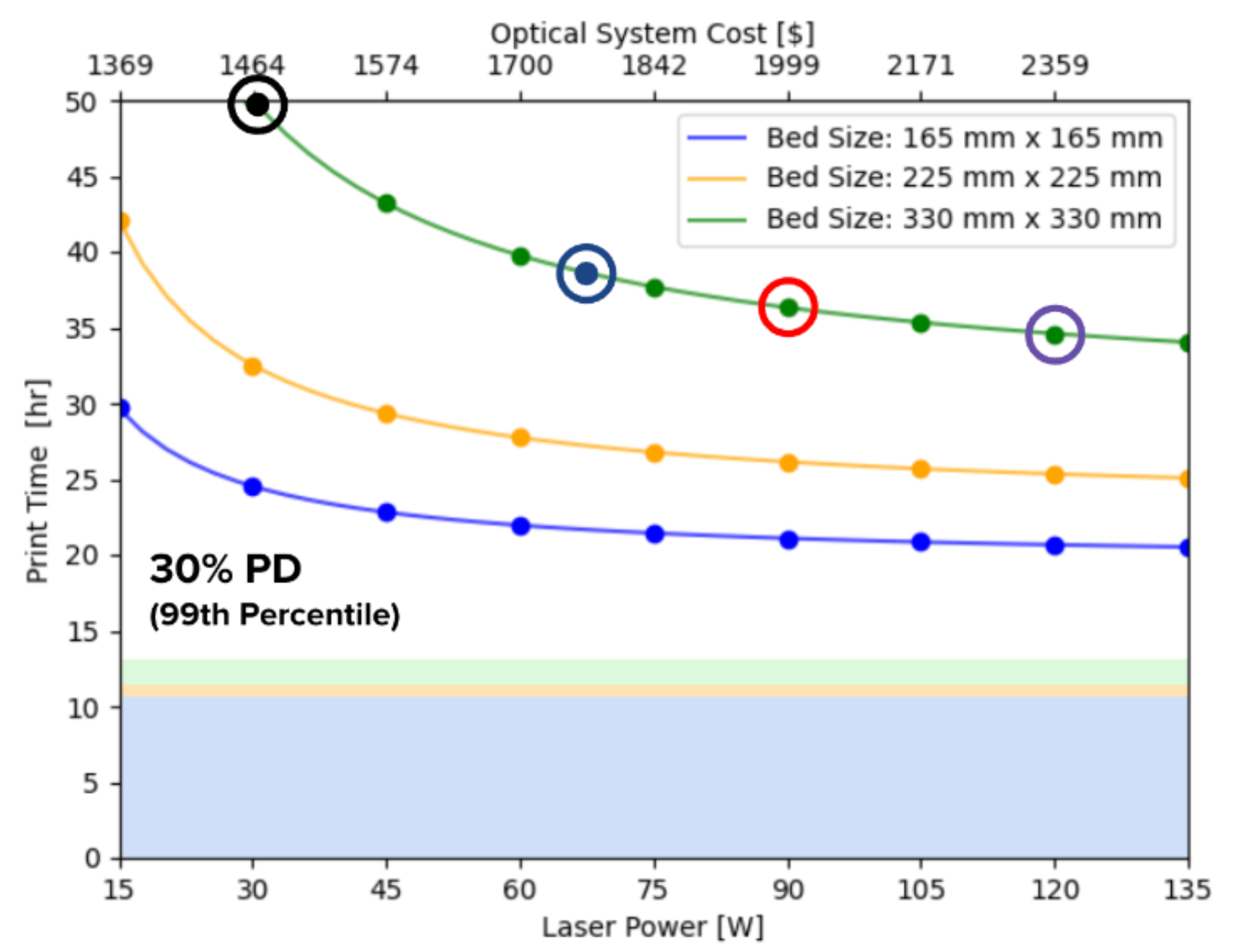
Systematic study of high-power lasers (30W-120W). Introduced peak irradiance as key metric and recommended 70W/500μm as optimal configuration.
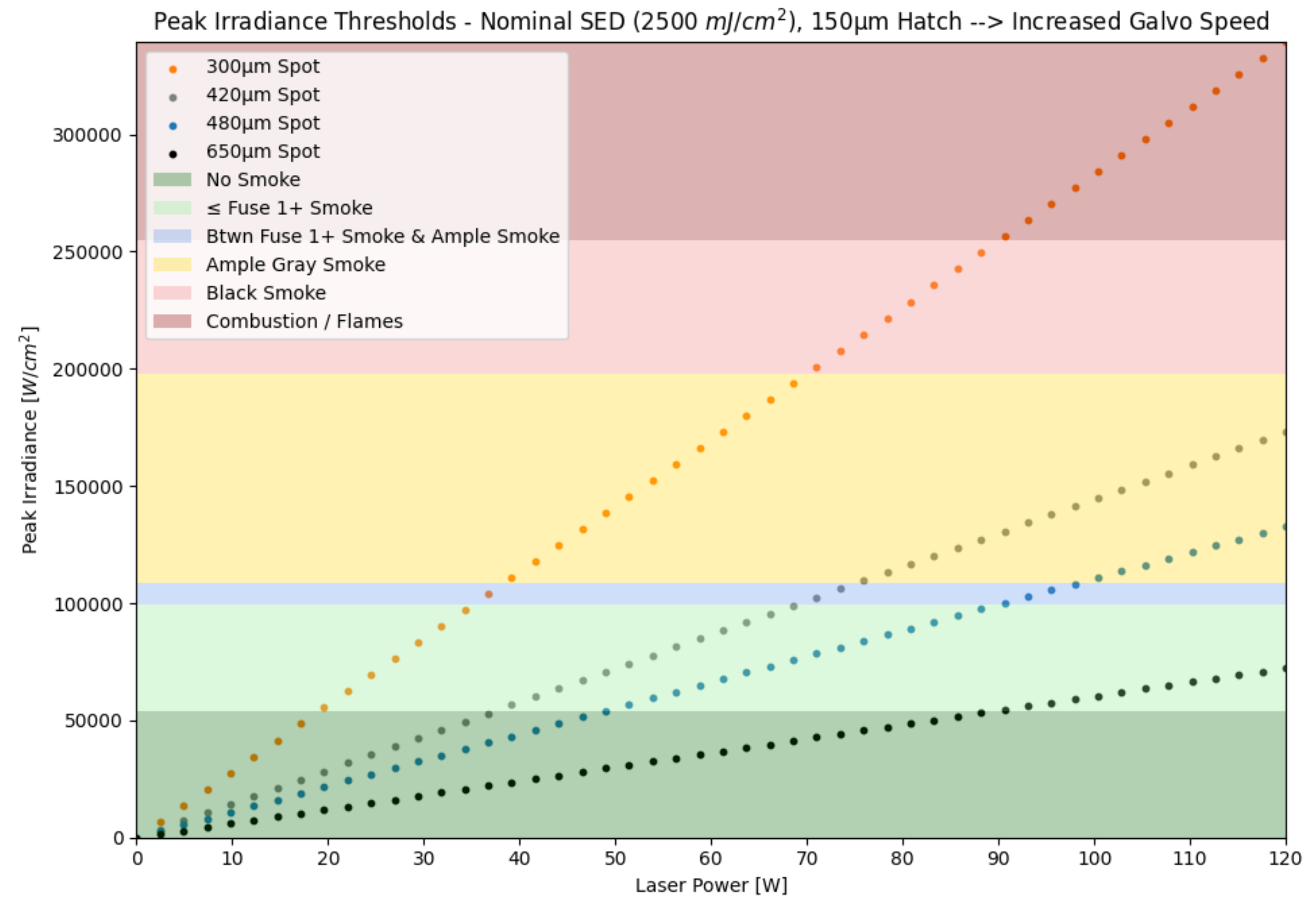
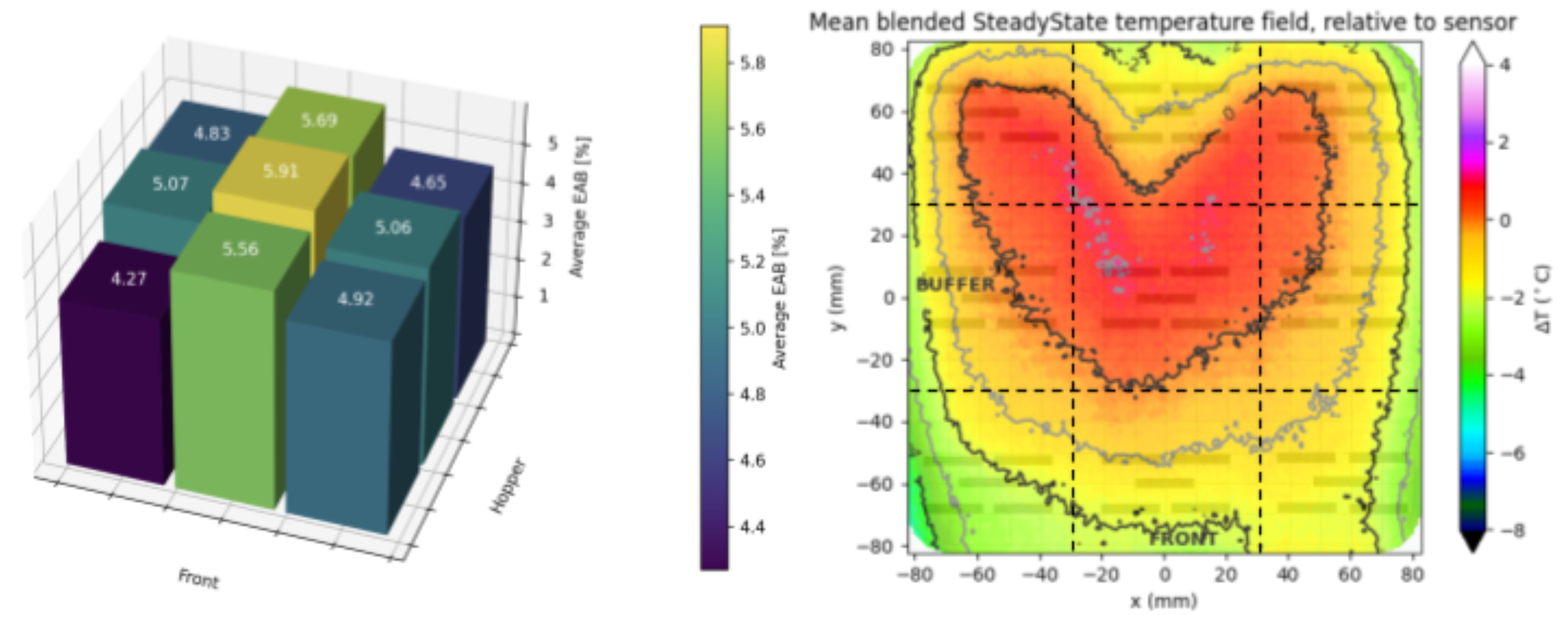
Correlated bed temperature distribution with part quality. Found thermal uniformity drives elongation at break (6% center vs 4% edges).
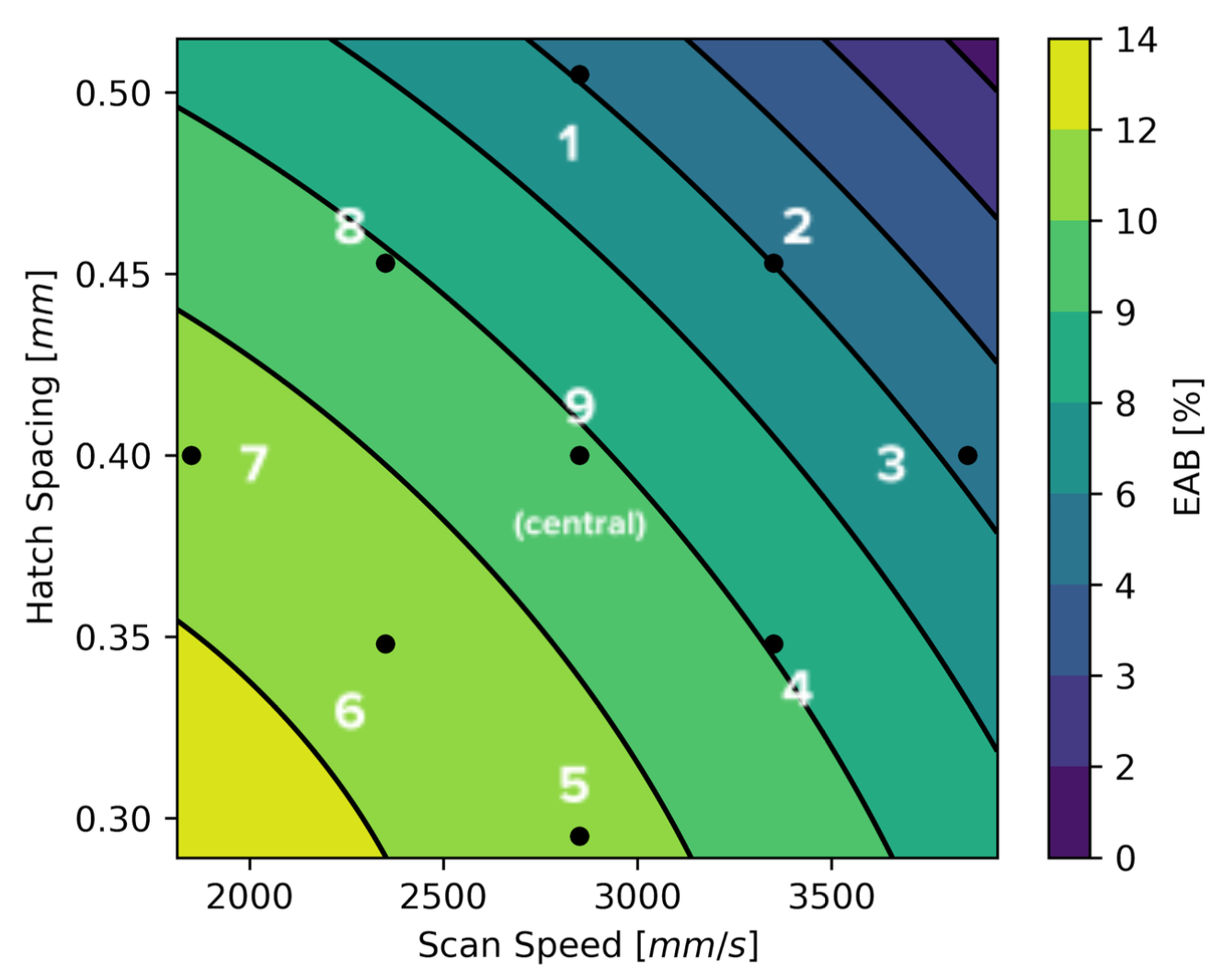
Proved 800μm spot feasibility via Central Composite Design. Achieved 40% Z-EAB improvement and ~10% speed gain.
Challenged industry assumption of 104 W/cm² threshold. Proved Nylon 12 prints at 336 W/cm² (30x lower), validating VCSEL array feasibility.
April 2023 - September 2023
May 2021 - April 2023
TPM responsibilities detailed in featured section above.
Print Process Engineering:
May 2019 - September 2019
Georgia Tech • Digital Design & Manufacturing Lab
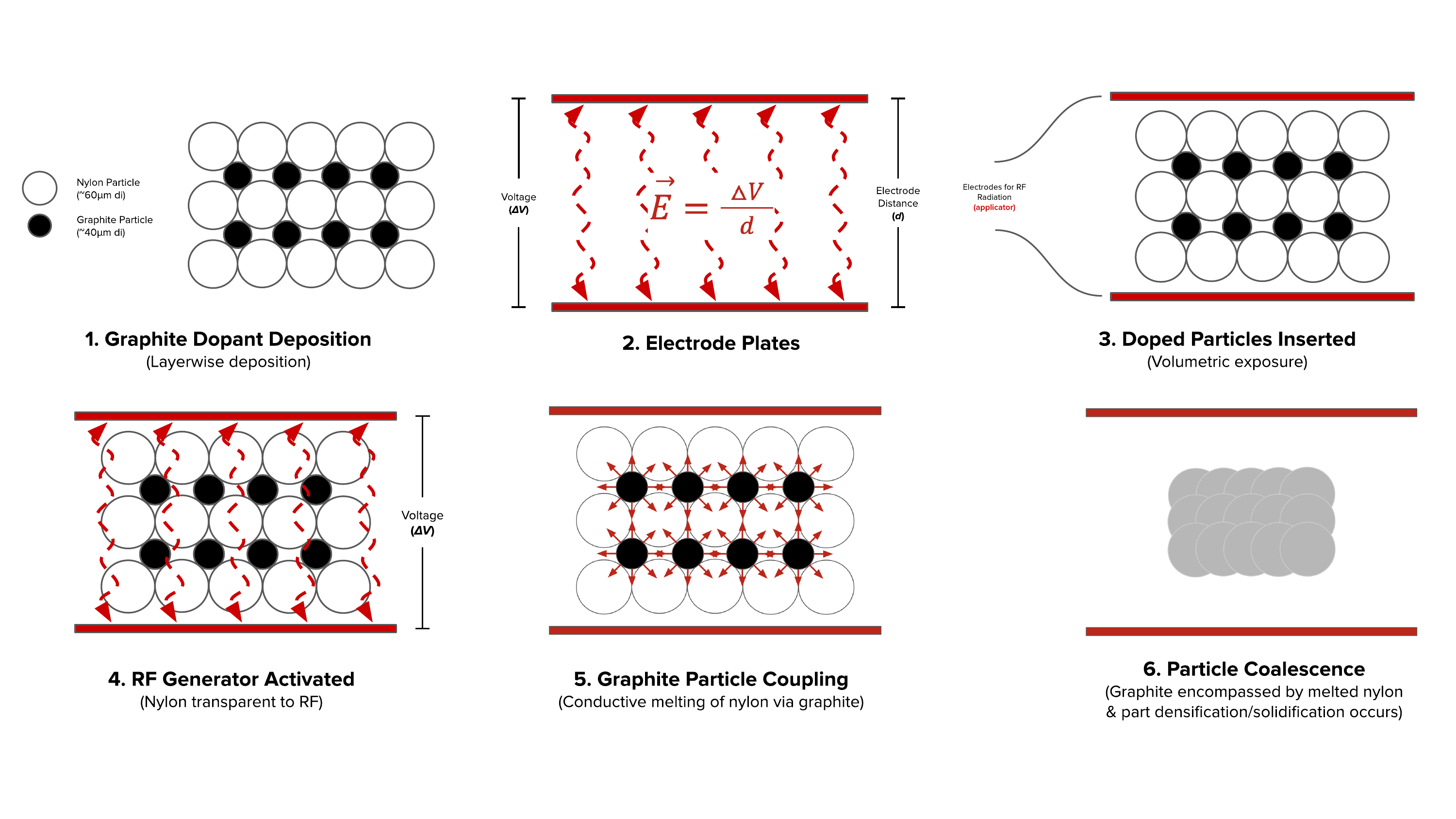
RFAM is a new polymer powder-bed process combining layerwise dopant deposition with volumetric RF heating. Carbon/graphite-doped nylon powder is exposed to an RF field between copper electrode plates; the dopant selectively absorbs RF energy and melts the surrounding nylon. The resulting platform replaces sequential laser scanning with parallel energy delivery and creates a new process-design problem spanning material patterning, electromagnetic fields, heat transfer, and densification.
Conductive ink is printed into each powder layer, exactly where the part should be. RF energy then passes through the entire build at once, but only the ink-doped powder absorbs it and fuses. Nothing scans and nothing traverses, so a whole cross-section, or a whole part, is heated in parallel. These renders were made with HEATR for a Nazdar press release and are illustrative rather than a specific solved run.
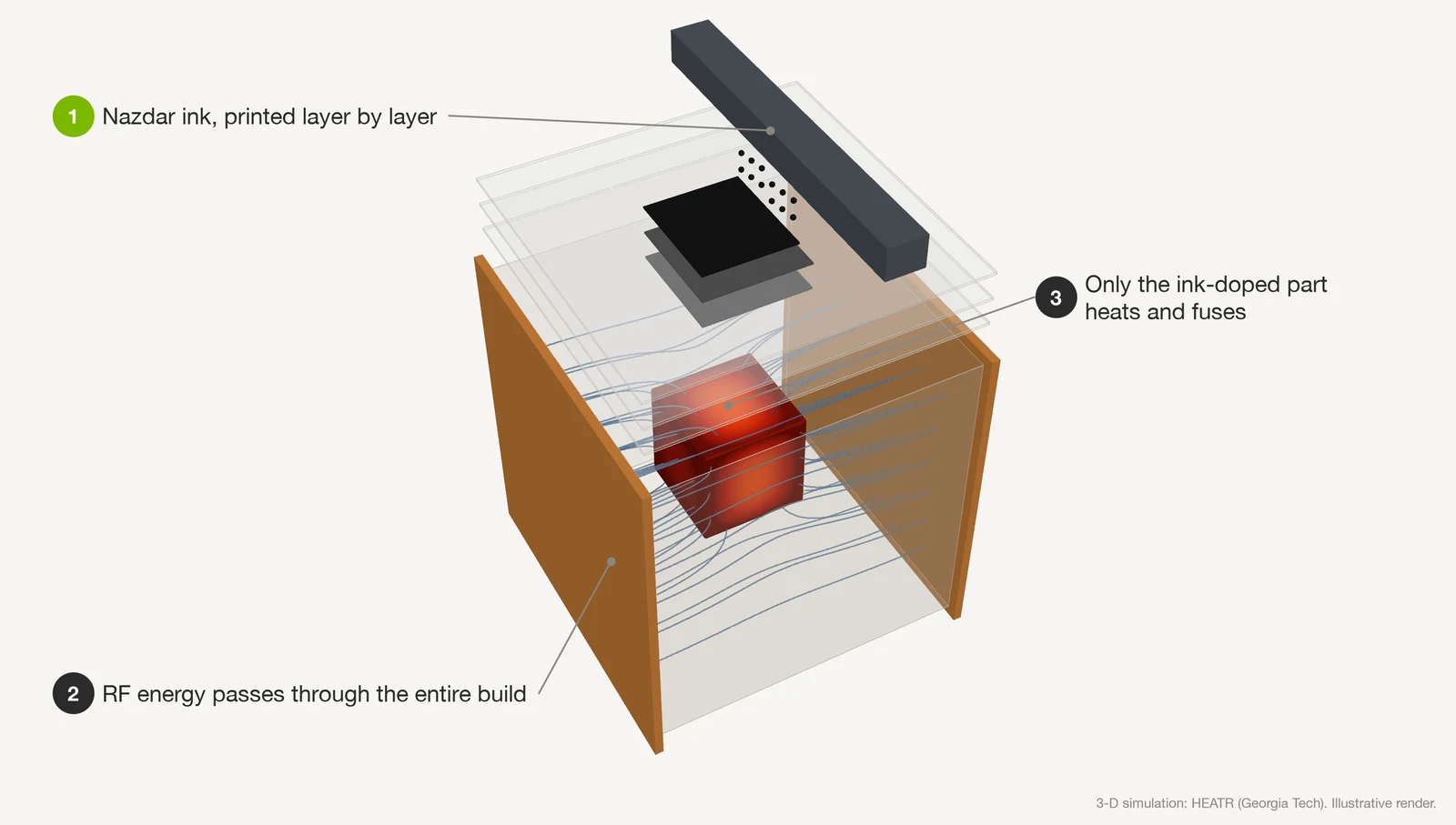 Print the Ink, Energize the Whole Build
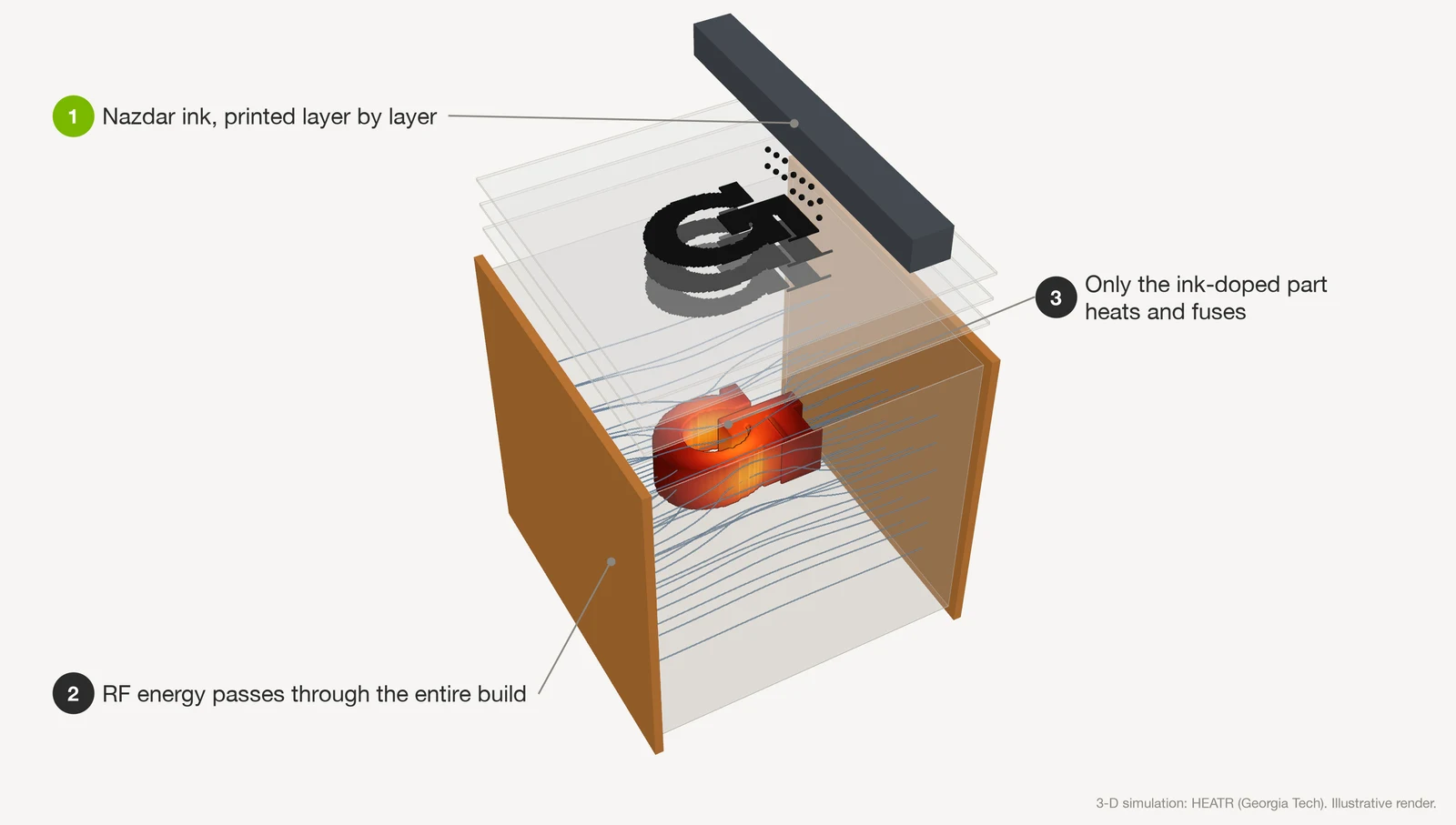 Any Cross-Section, Heated at Once
The renders show the intent. This is the machine doing it: a doped test part under RF, imaged with a FLIR A70 after about two minutes of heating. To the eye it is a dark patch in a bed of white powder. To the camera the doped region is the only thing above room temperature.
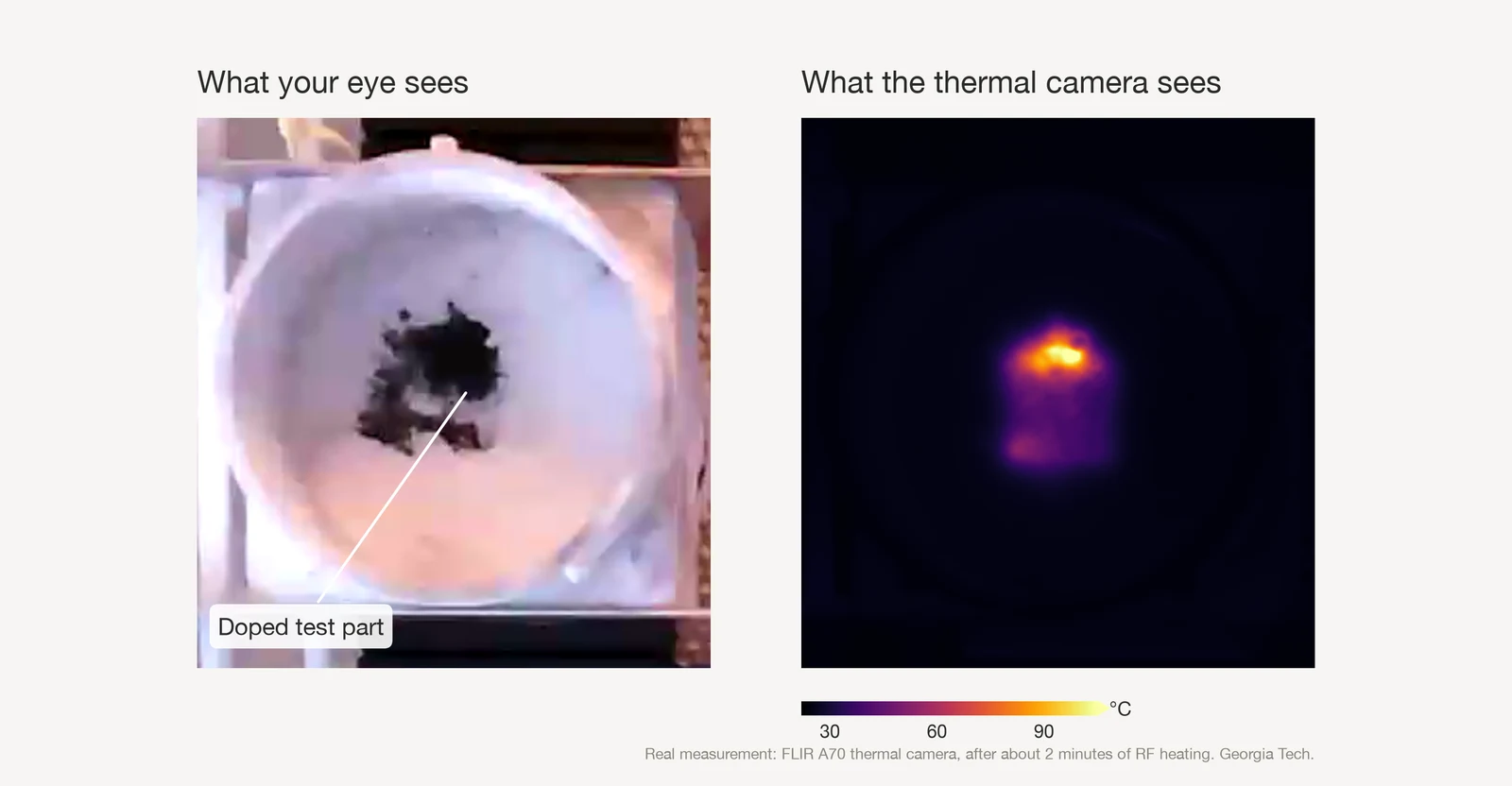 Visible vs Thermal: Only the Doped Part Heats
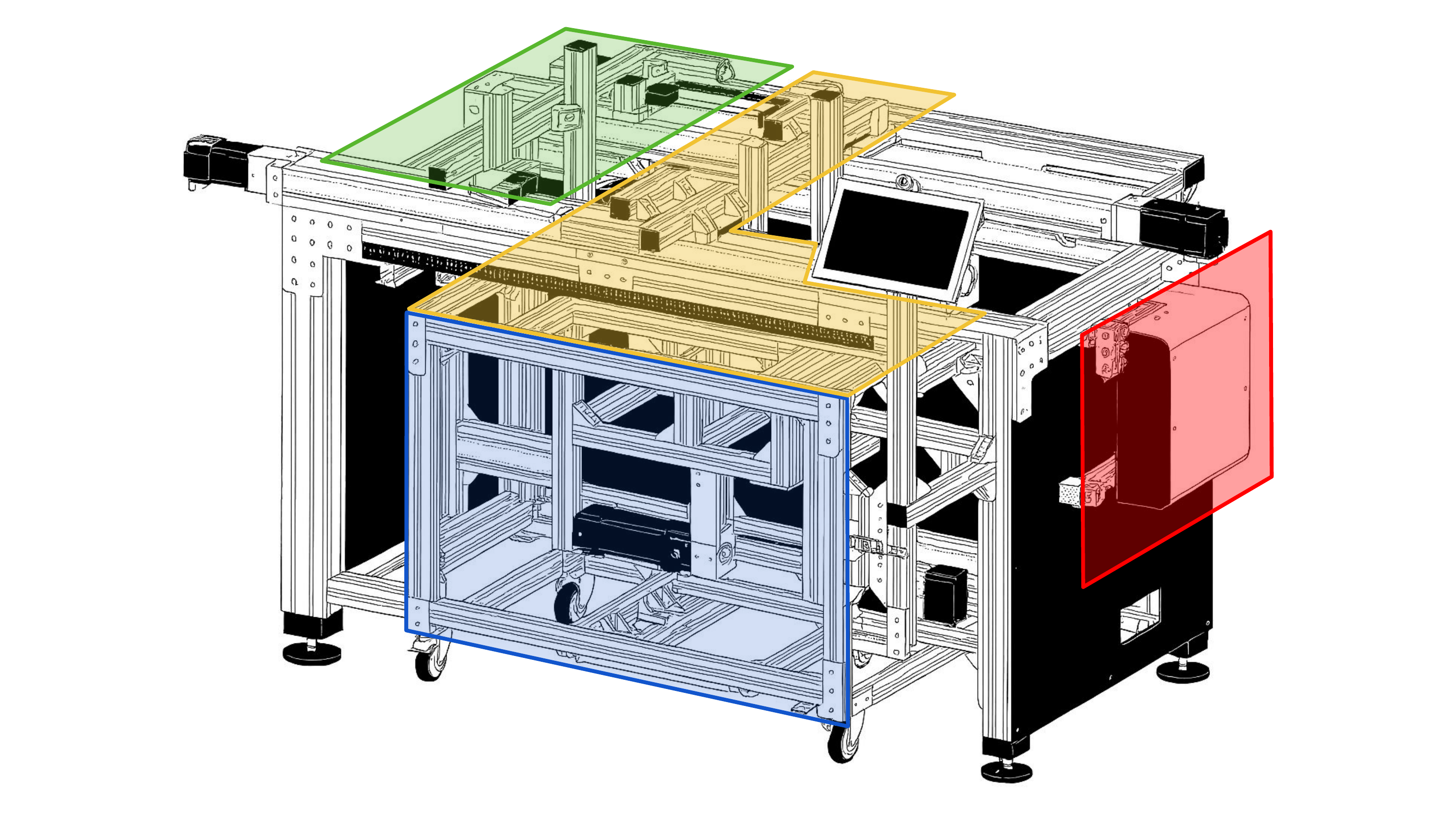 Custom Binder Jet Platform
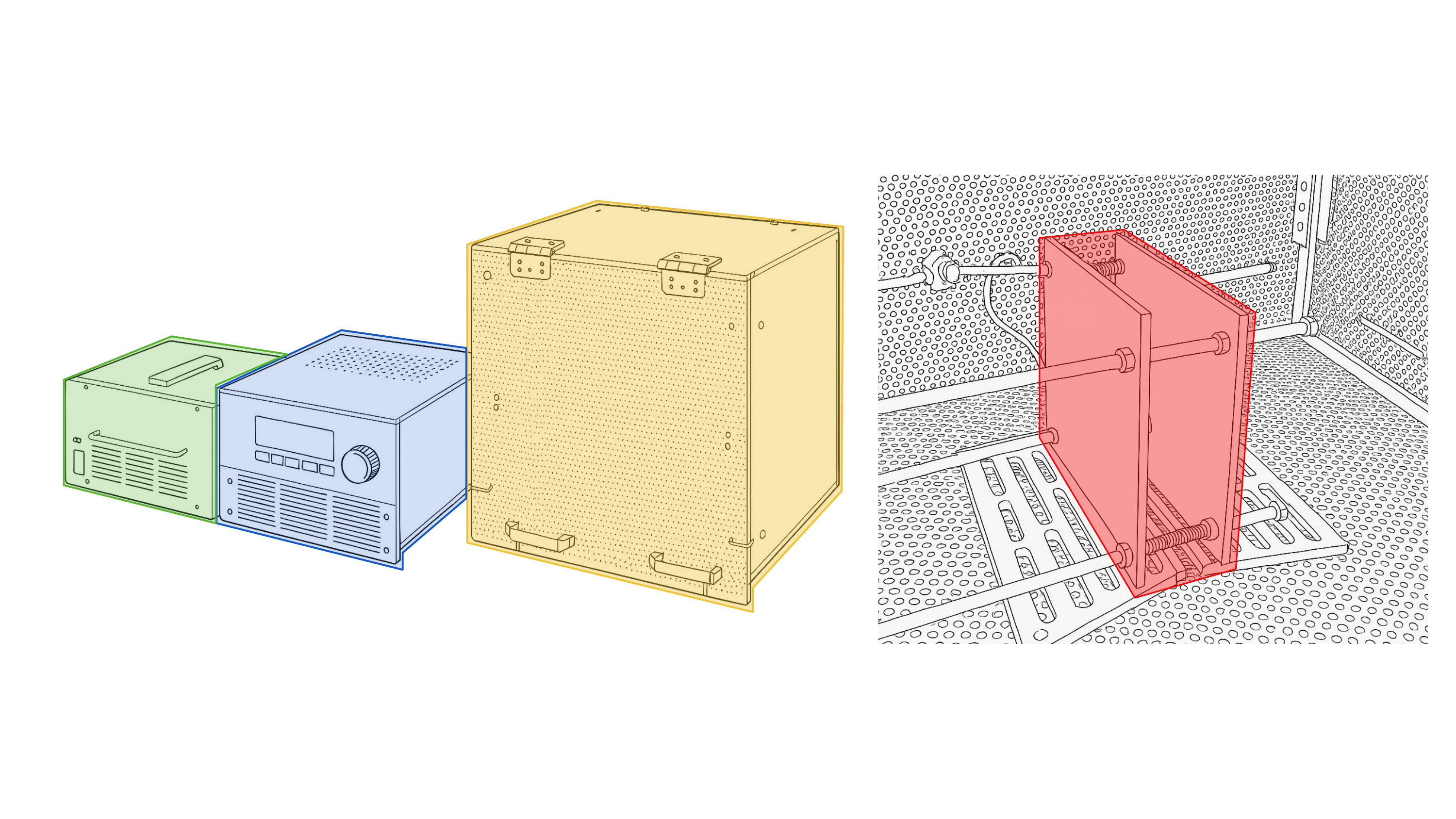 RF Heating Station
 Sintering Workflow
 Task 2: Modeling
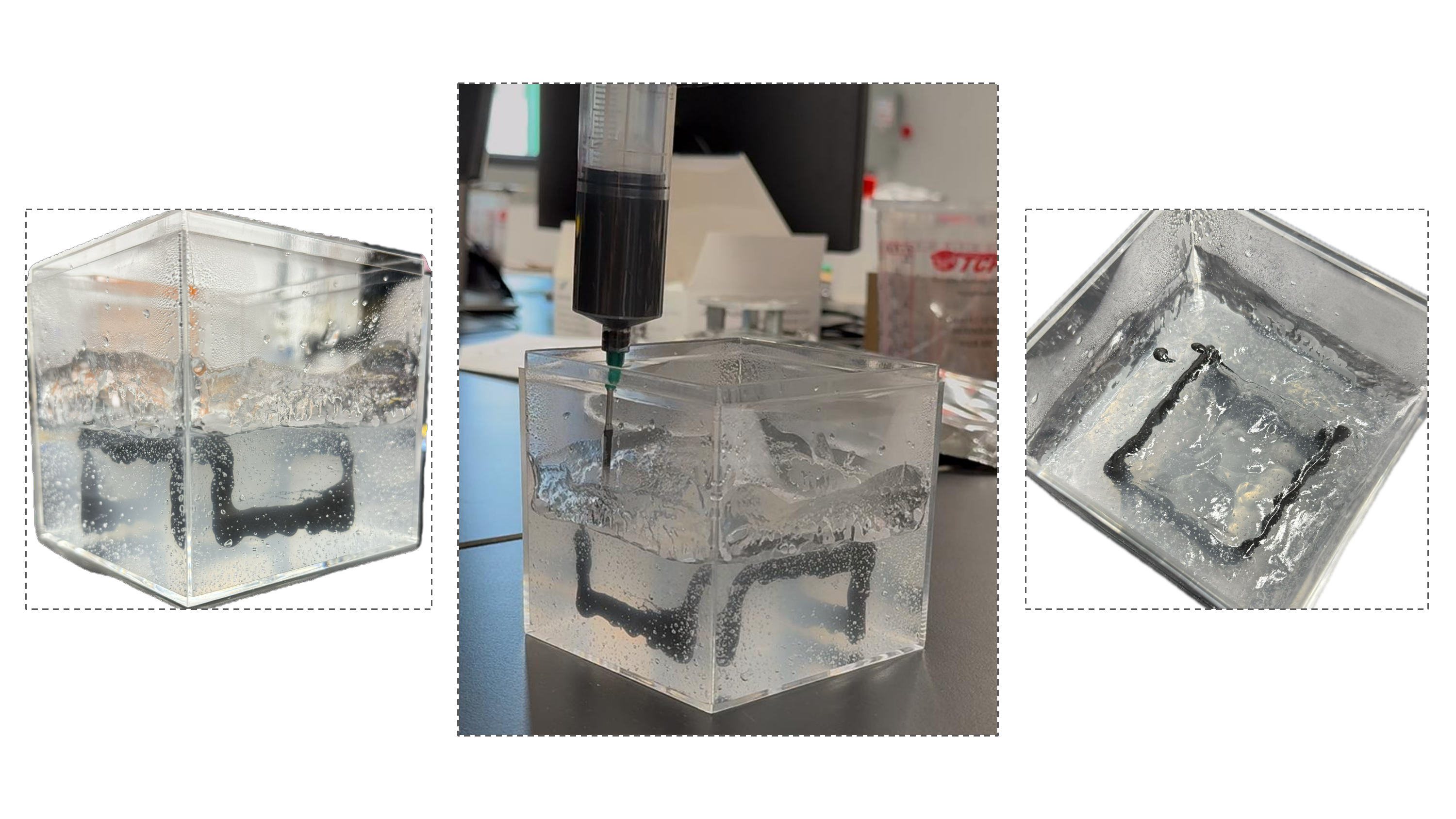 Task 3: Bath Printing
RFAM Machine
Task 3: Bath Printing
RFAM Machine
I developed a cross-platform desktop application for controlling the APS Engineering NANO 700 ink delivery system used on the RFAM platform. Built with Electron and the Web Serial API, the app provides serial device control, real-time system monitoring, data trending via Chart.js, configurable settings, and a filterable event log—all with full dark and light theme support. It builds for macOS, Windows, and Linux.
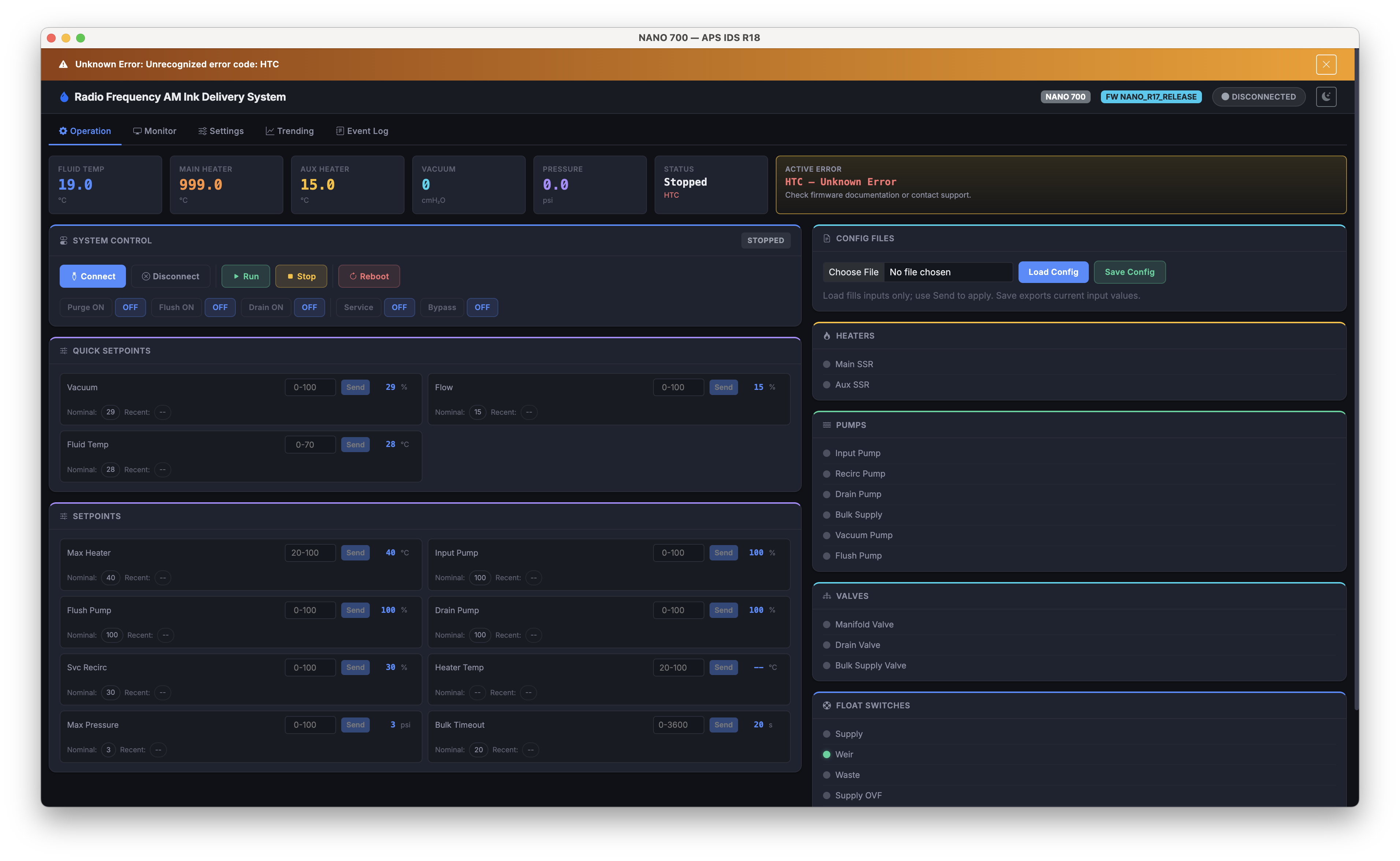 Operation (Dark Theme)
 Operation (Light Theme)
 Real-Time Monitor
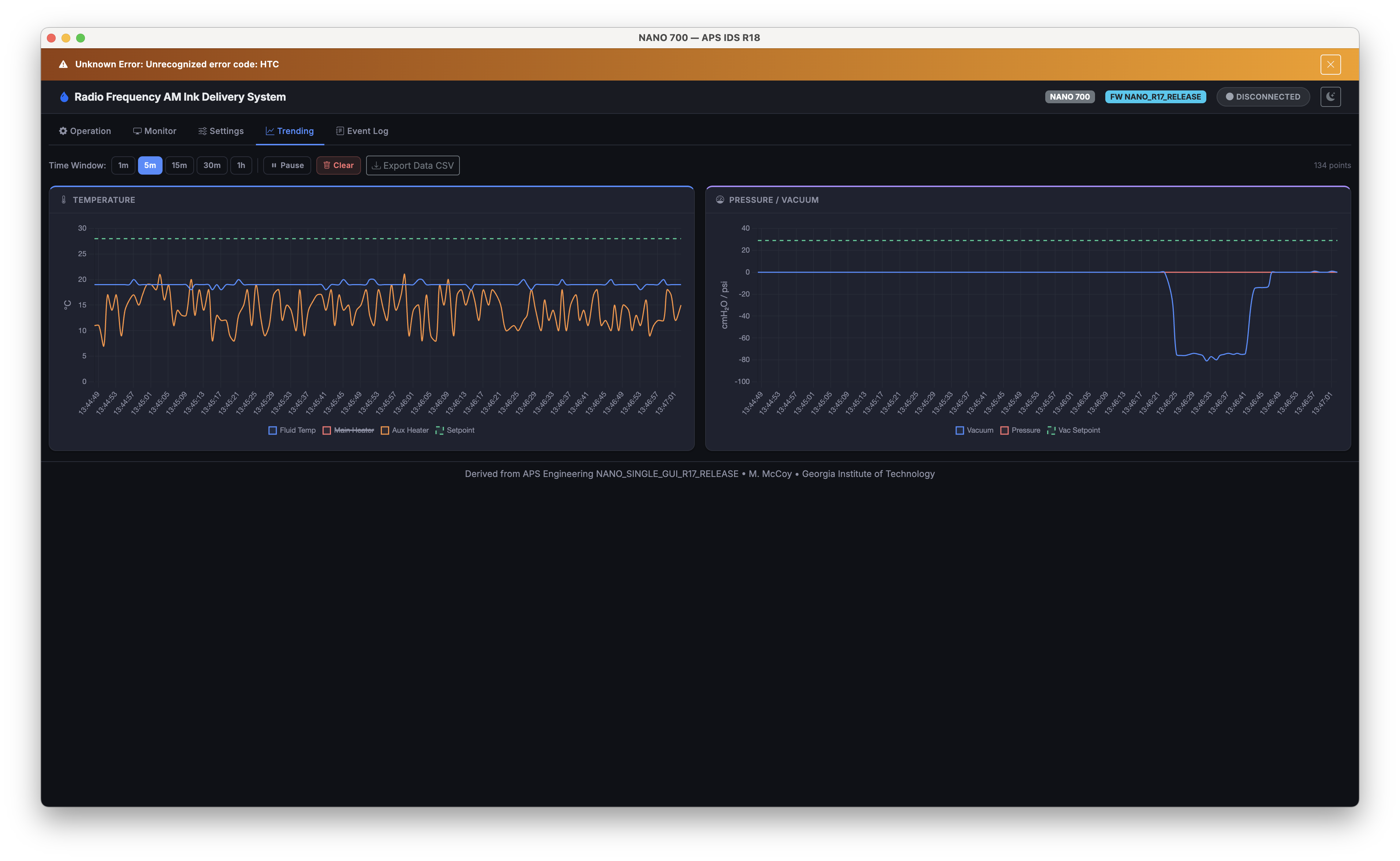 Data Trending
 Settings
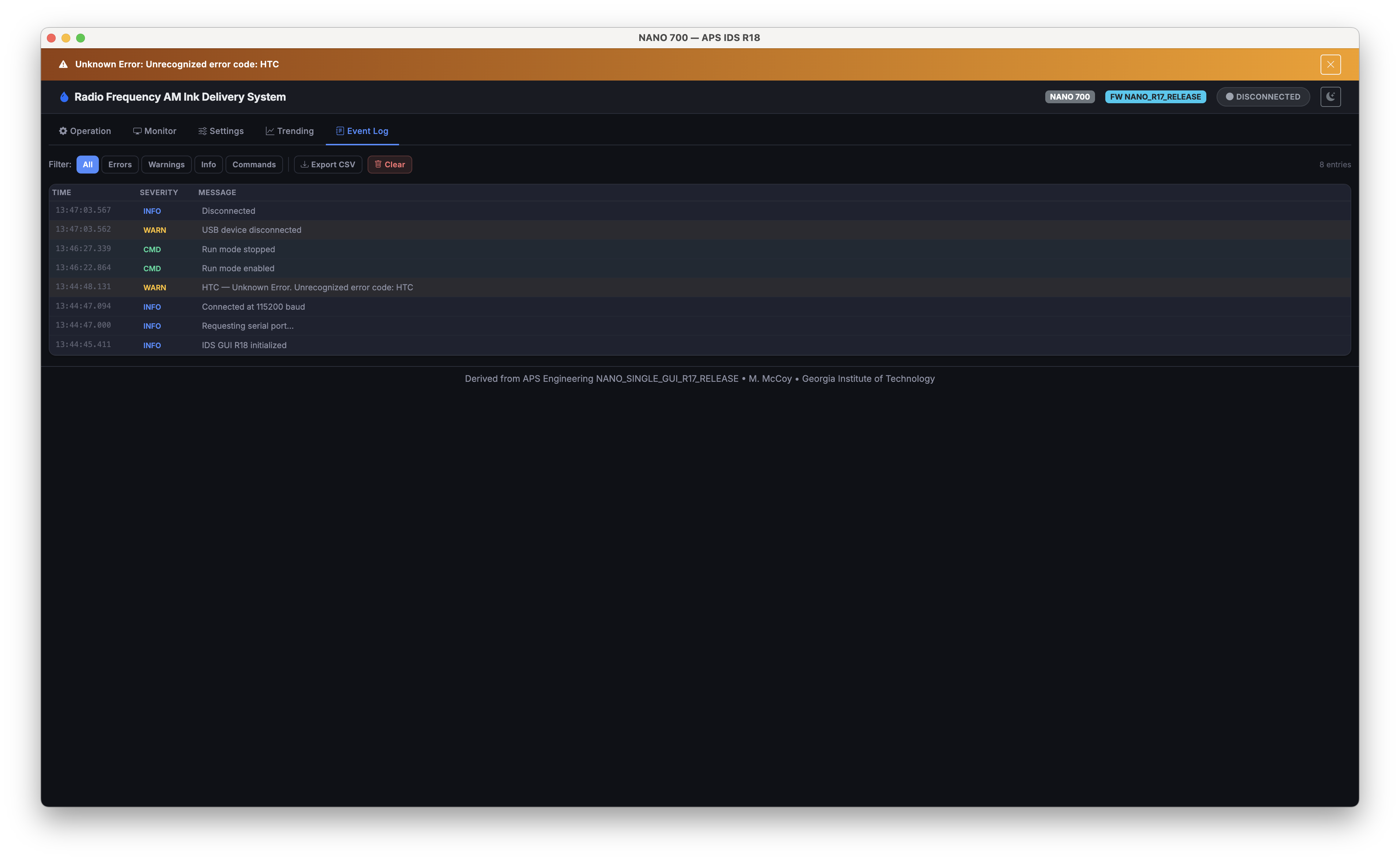 Event Log
Solid Freeform Fabrication Symposium 2026 • Austin, TX
Geometry-Dependent Sintering Nonuniformity in RFAM. A talk on HEATR—a coupled electromagnetic–thermal–sintering solver for radio-frequency additive manufacturing—and the simulation-guided compensation framework it enables: graded dopant, exposure scheduling, and a design-for-RFAM capability envelope.
Solid Freeform Fabrication Symposium 2025 • Austin, TX
Proposal presentation (September 2025)
The automatic tuner could not hold a match into a load whose impedance moves as the powder melts, so I built the matching network by hand and instrumented it. That work turned up a failure that had been corrupting every thermal measurement on the machine, and it ended with the first part this platform has fused.
The symptom was that the FLIR camera dropped out under power and the thermal images carried RF noise. The cause was mechanical. The coax entered the Faraday cage through a plastic-lined wall slot and its connector hung on zip ties, making no metal contact with the cage, so the shield was never bonded to the wall. The network's secondary sits at kilovolts, and the stray capacitance from that secondary to the cage carries a current that has to get back to the generator. With no bond at the wall it returned over the outside of the coax and the ground wire, which put RF on the cage, its frame, and the camera mount. The fix was a braid strap from the coax flange to the cage wall.
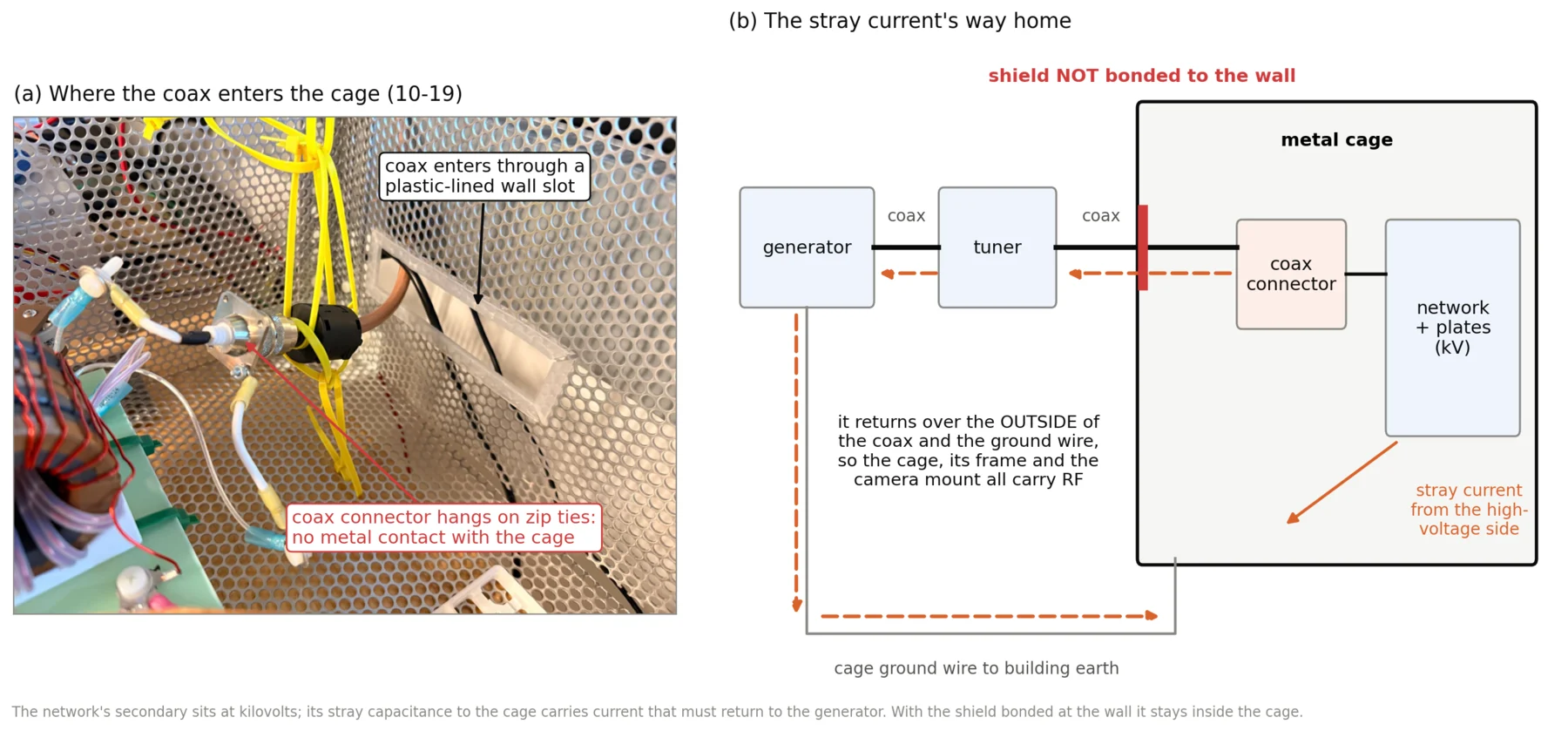 The Cause: An Unbonded Shield
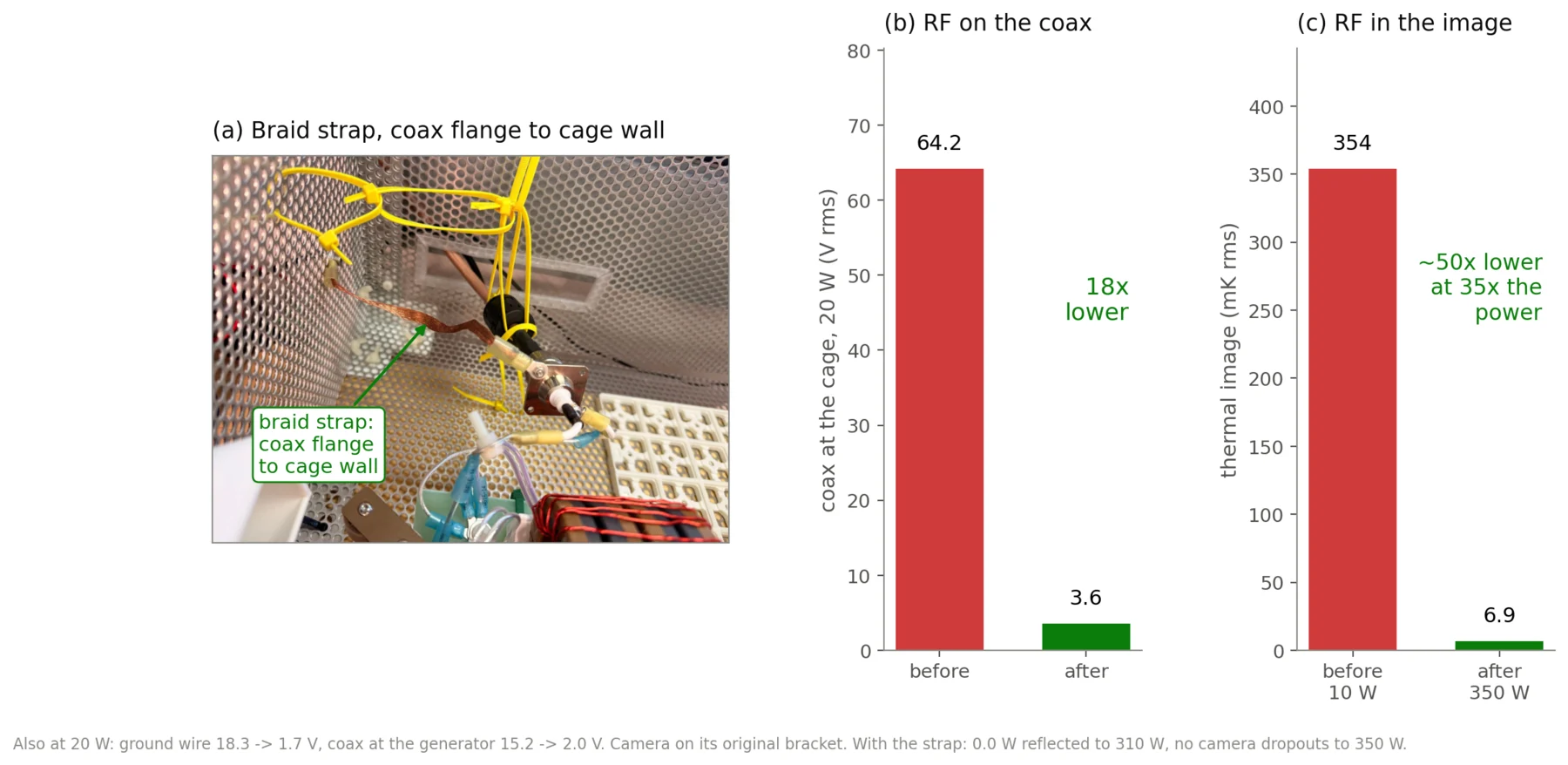 The Fix: Bonding the Shield at the Wall
With the camera trustworthy again, the same thermal imaging could be turned on the network. At the end of a 300 W hold the hottest spot was the circuit board beside the first high-voltage post at 90 °C. Scaling that rise with power puts the same spot at 118–135 °C at 500 W, against an FR4 softening point near 130 °C, so the board becomes the binding constraint before the generator does. That is a projection from the 300 W measurement rather than a measurement at 500 W, and it is why the next run targets a constant 250 W rather than pushing the top end. RF interference in the image stayed between 0.9 and 1.6 mK at every step of the sweep.
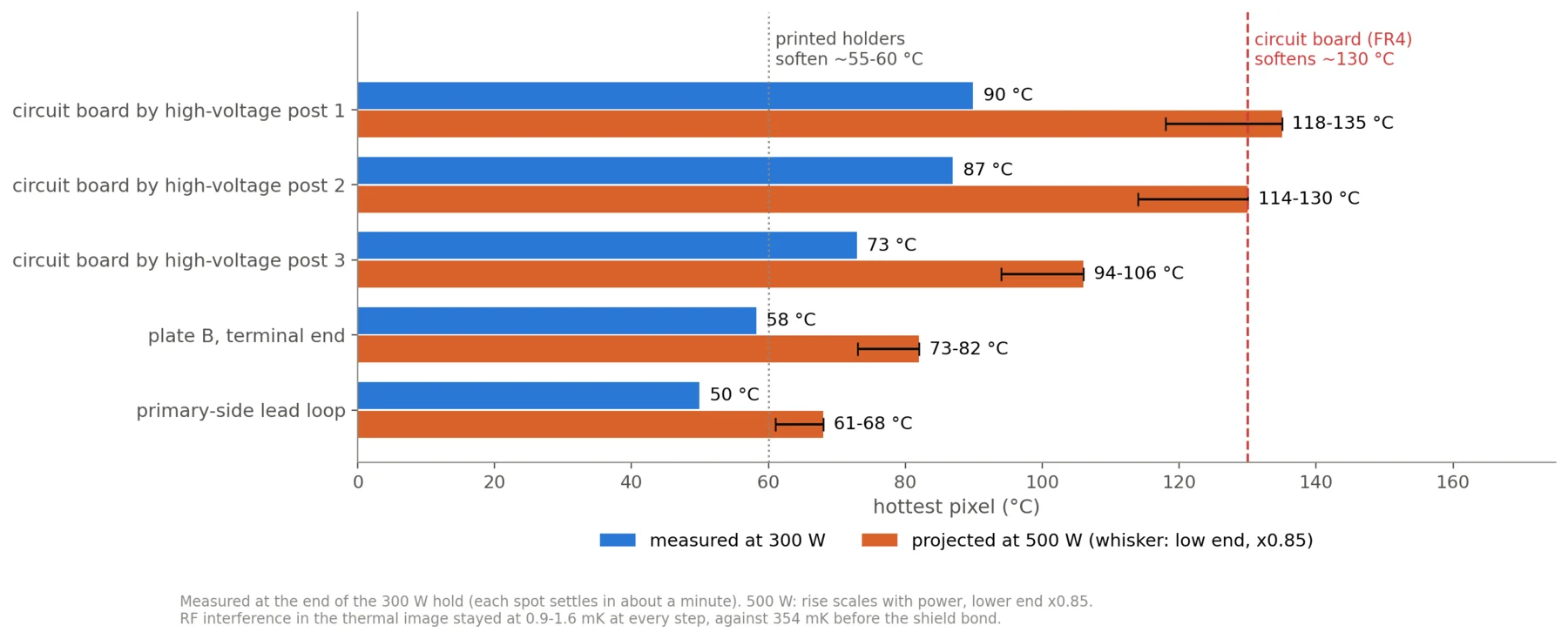 Where the Network Runs Hot
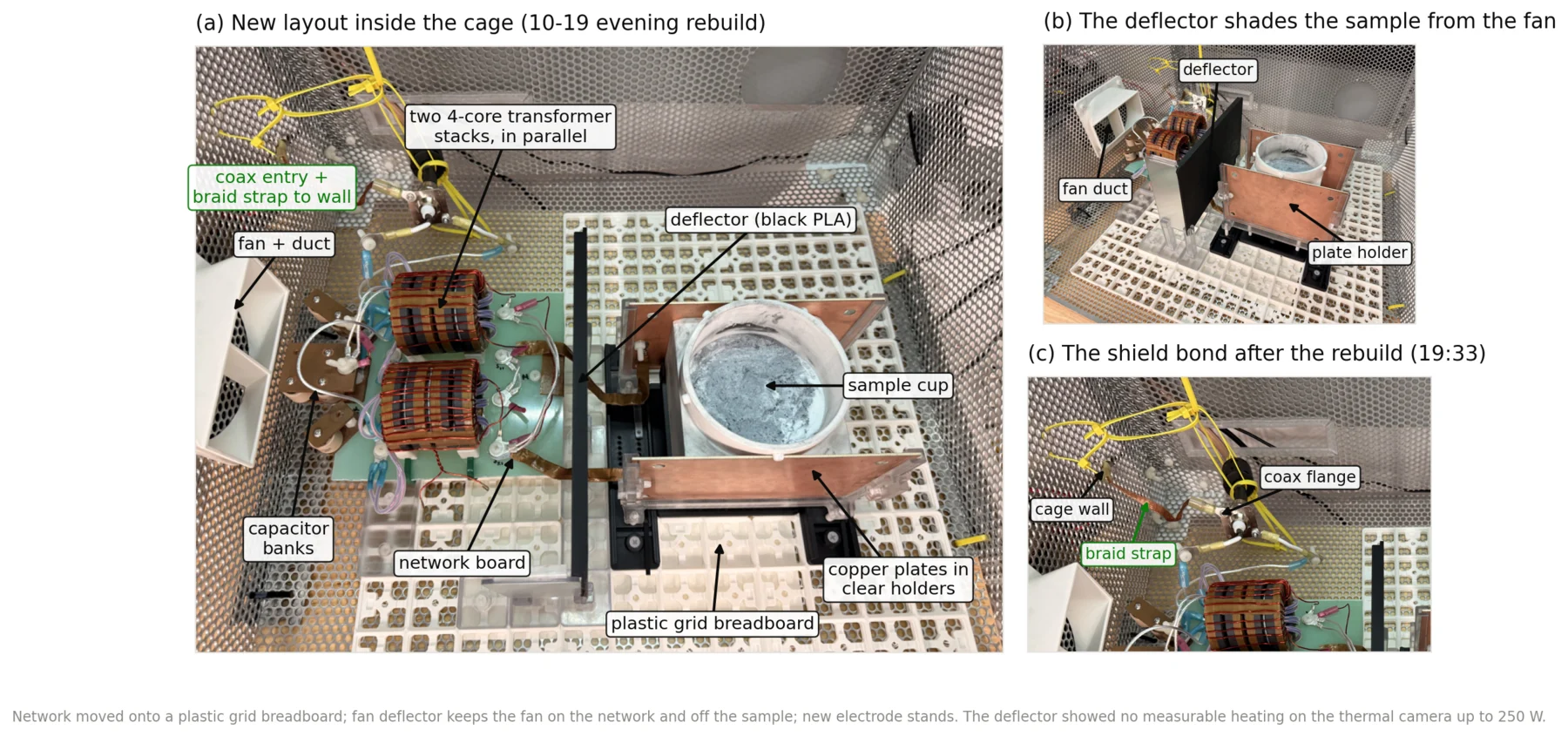 The Rebuilt Network
A 25.4 mm doped cube was ramped to 300 W. It collapsed at 553.7 s and smoked from its center about 75 seconds later. What came out of the bed was a fused body of 59.8 × 40.5 × 16.5 mm weighing 20.6 g, of which roughly 12 g was undoped nylon that had never been printed with dopant at all. Melting had run 9 mm across the field and 17 to 21 mm along it.
That extent is the interesting part. A quasi-steady melt-front estimate says conduction alone would need the cube face held somewhere between 400 and 700 °C to melt 19 mm along the long axis, and nylon degrades above about 350 °C. So conduction does not explain the part. Two possibilities remain open: RF heating of the hot undoped nylon once it is above its own transition, or doped powder that spilled into the surrounding bed. Distinguishing them is the next experiment, not a settled result.
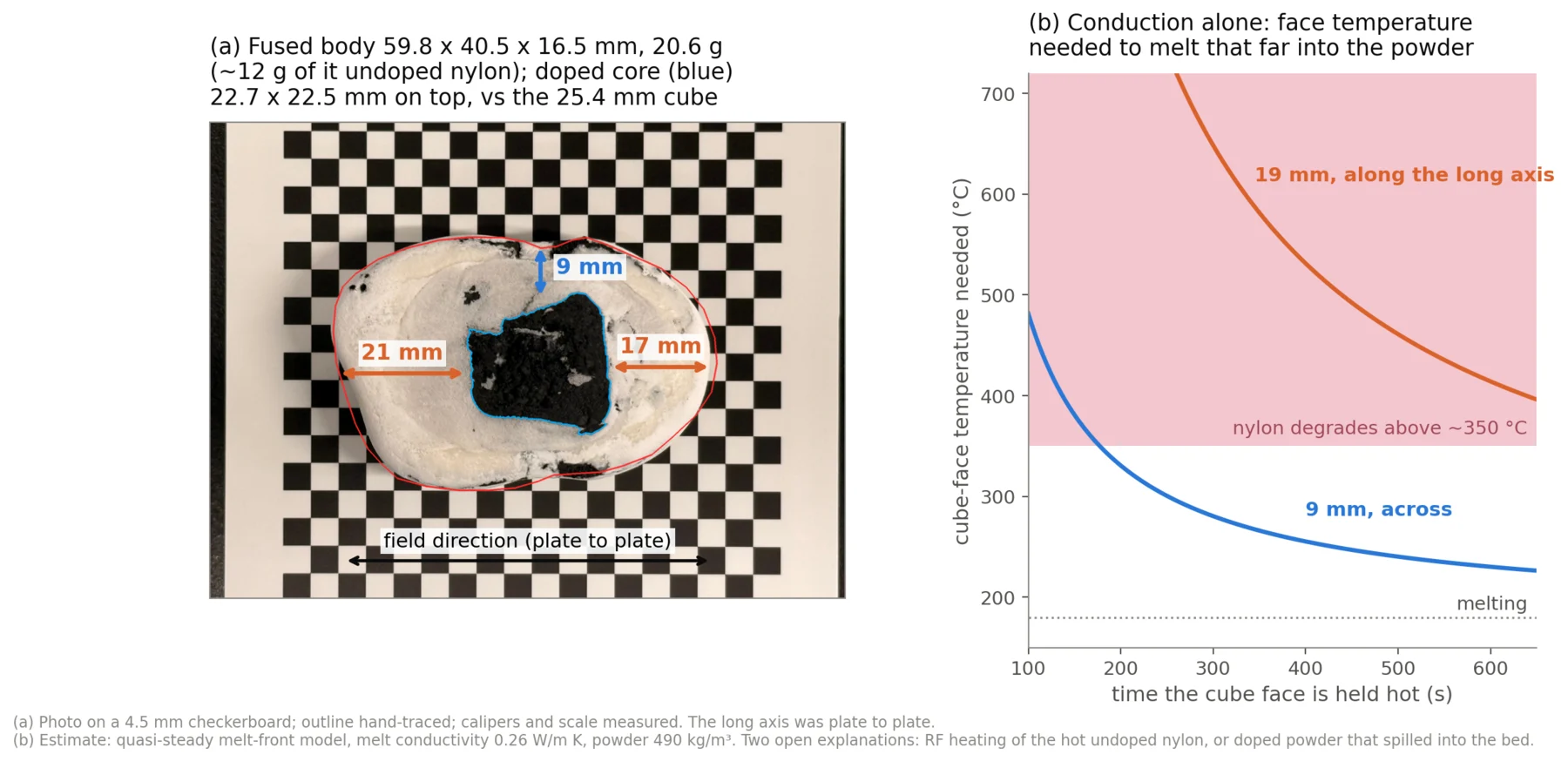 Fused Body and the Conduction Argument
Dr. Carolyn C. Seepersad (Woodruff School Chair & Professor) & Dr. Christopher J. Saldaña (Ring Family Professor)
Coupled RF, thermal, phase-change, and densification simulation
HEATR is the coupled 2.5D/3D forward and inverse-design platform I built for RFAM. It connects a complex-coefficient electro-quasi-static field solve to generator-power-scaled RF deposition, transient heat transfer, DSC-calibrated phase change, and viscous-capillary densification. The same physics then runs in reverse: a finite-difference-verified adjoint computes how every printable dopant cell changes the final melted geometry, enabling the software to convert target parts into machine-ready material maps and exposure instructions.
A short field guide to HEATR — the electrothermal pipeline (field solve → RF power → melt → densification), then launching a run and reading the results.
HEATR field guide • loops automatically • drag the scrubber to review any moment
The second-generation solver minimizes shape error directly, penalizing both unfused material inside the target and melt that escapes into the surrounding powder. One backward adjoint sweep returns the gradient for every dopant cell at roughly the cost of one forward solve. The pipeline jointly selects the dopant field and exposure stop, then filters and quantizes the result to the machine's 4-bit raster convention before re-running it through the production forward model.
Across the standardized 18-shape library, the printable single-pass map beat uniform dopant on all 18 shapes and the best stored historical map on 13. Seven shapes reached the absolute solved class of melt-region IoU ≥ 0.95. Four-bit quantization changed IoU by no more than 0.0035 across the census, showing that the optimized structure survives the transition from a continuous design variable to a printable instruction.
 18-Shape Adjoint Design Census
Three-Dimensional Solved Map
18-Shape Adjoint Design Census
Three-Dimensional Solved Map
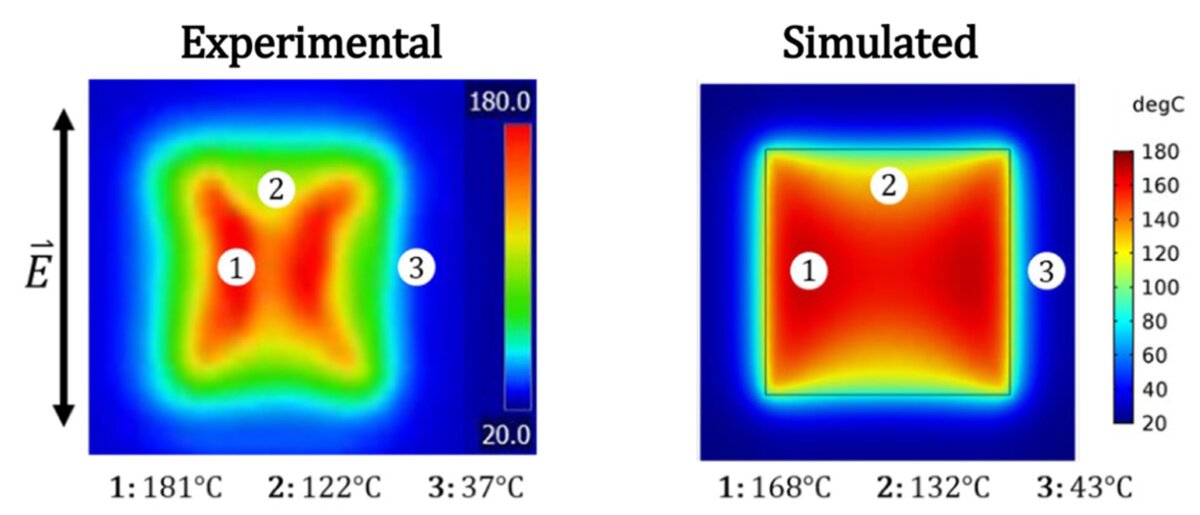
In a parallel-plate RF field, energy coupling is not uniform. Corners and edges perpendicular to the applied field concentrate the E-field dramatically, while surfaces parallel to the field couple weakly. This means every different geometry produces a different heating pattern, and for non-symmetric shapes the results can be severe: one region of a part can be fully sintered while another barely reaches melt temperature. This is not a bug you can engineer away at the system level. It is an inherent feature of EQS heating. The only path forward is to understand the coupling for each geometry and develop compensation strategies that work around it. That requires a simulation tool fast enough to explore the space systematically.
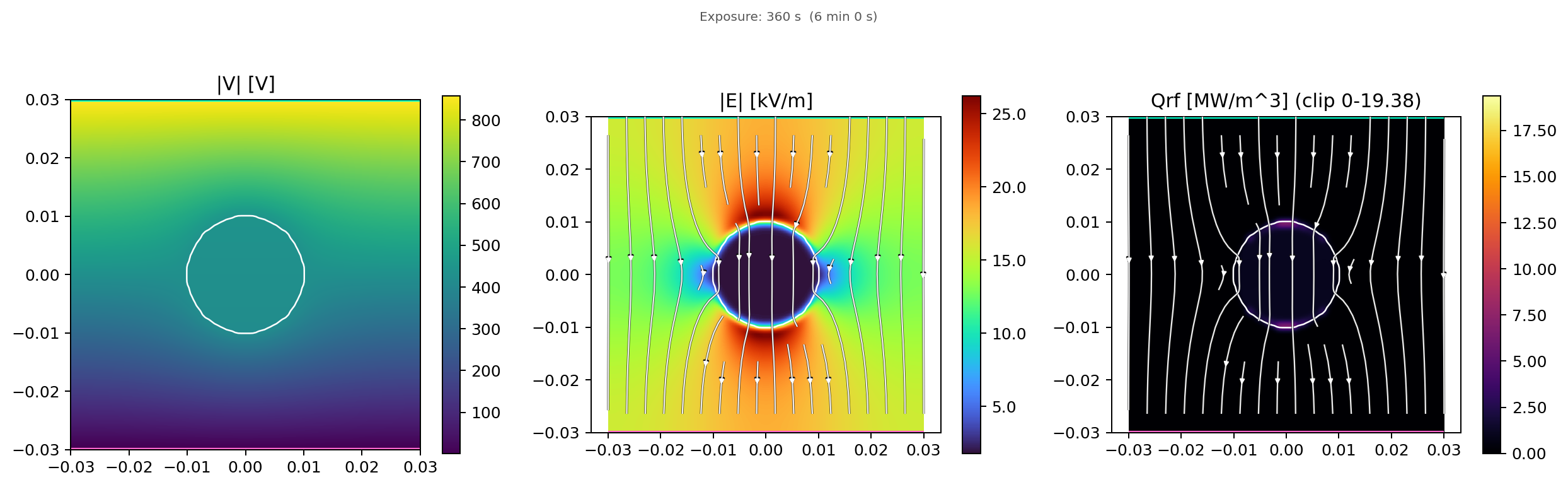 Circle: Voltage, E-field & RF Heating
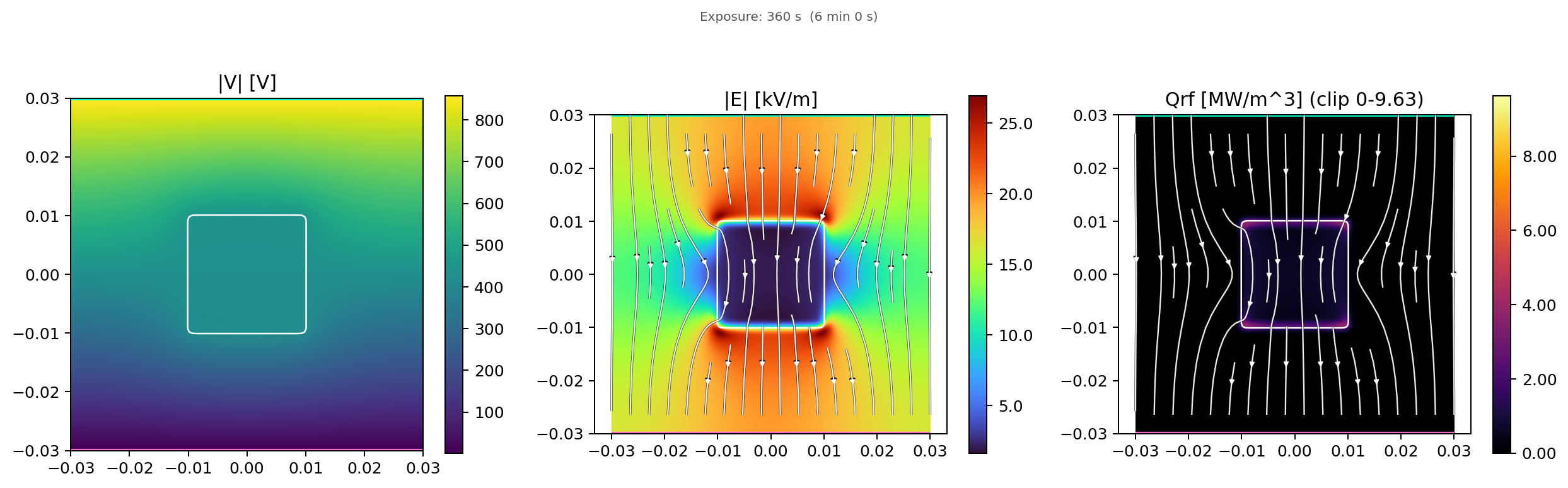 Square: Voltage, E-field & RF Heating
COMSOL can assemble the same coupled physics, and it remains an independent reference for HEATR. The advantage is not an exaggerated single-solve speed claim: a comparable transient case takes roughly 30 seconds in HEATR versus 60–70 seconds in COMSOL. The decisive difference is throughput and control. HEATR carries no per-run meshing, GUI, or license-seat overhead, so hundreds of unattended geometry, orientation, grading, and adjoint evaluations are scriptable. Owning the forward model also makes it possible to embed custom densification endpoints, quantization gates, inverse-design objectives, and exact adjoints directly in the solve.
 Forward + Adjoint Design Loop
 Ungraded vs. Adjoint-Designed
The animation below contrasts a one-shot proportional inverse mask with the adjoint solve. Instead of inferring a correction from a proxy field, the adjoint repeatedly evaluates the printable dopant map through the coupled RF, thermal, and densification physics, driving the final melted geometry toward the target.
 Hexagon: Proportional Inversion vs. Adjoint Solve
Some re-entrant and multi-lobed geometries remain limited by field shadowing or available power. HEATR can then search process actuators as well as material maps. These SFF 2026 animations show how rotation changes the heating kernel, how an indexed two-stage schedule melts an L-shape limb by limb, and how asymmetric dwell distributes energy across a cross. The results are simulation-established; the current electrode-medium contact architecture prevents physical turntable implementation without a hardware change.
 Rotation Changes the Heating Kernel
 Sequential L: Limb-by-Limb Exposure
 Cross: Asymmetric Dwell Schedule
Every run reports field maps, thermal and densification histories, energy-balance residuals, and numerical diagnostics. The forward physics is cross-checked against COMSOL on reference cases, and a one-parameter calibration against a recovered independent IR transient reproduces the measured time-to-melt. The adjoint is verified against finite differences before optimization and satisfies the forward/adjoint transpose test to machine precision.
The remaining boundary is explicit: dedicated full-field validation on the current RFAM machine has not yet been completed, and the model still uses published 30 wt% graphite-in-nylon electrical data as a stand-in for the deployed 25 wt% carbon-black ink. Absolute heating magnitudes therefore remain model-relative pending impedance spectroscopy and closed-loop IR validation. The compensation results are simulation-established, not yet experimentally demonstrated.
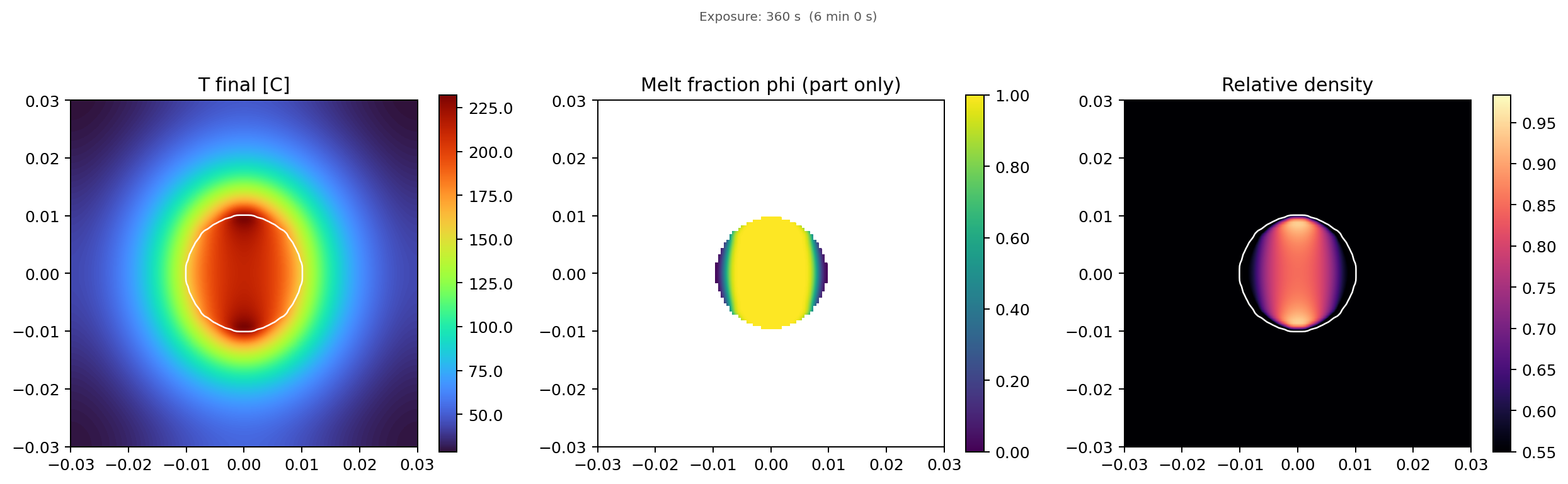 Circle: Temperature, Melt & Density
 Square: Temperature, Melt & Density
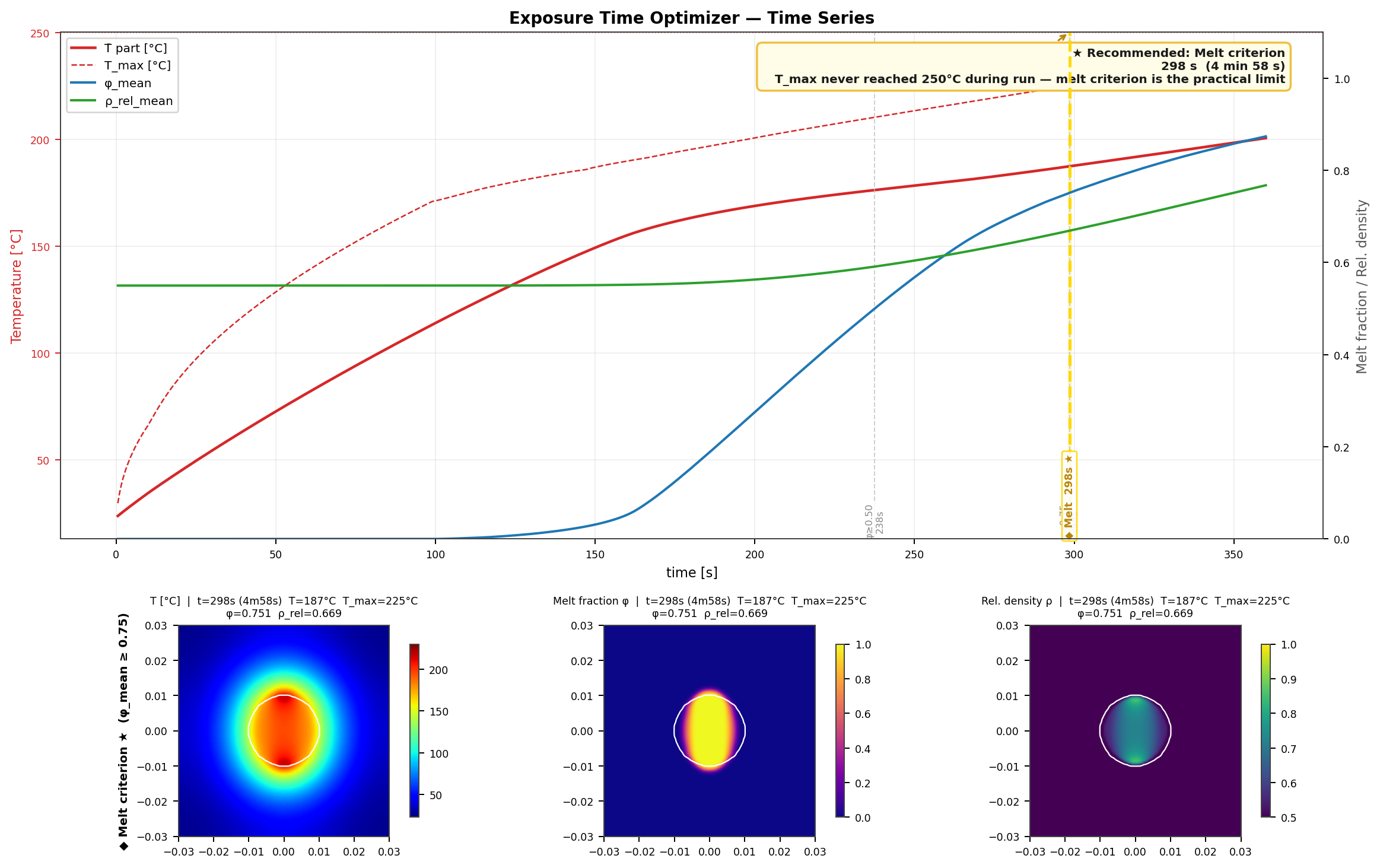 Optimizer: Convergence Report
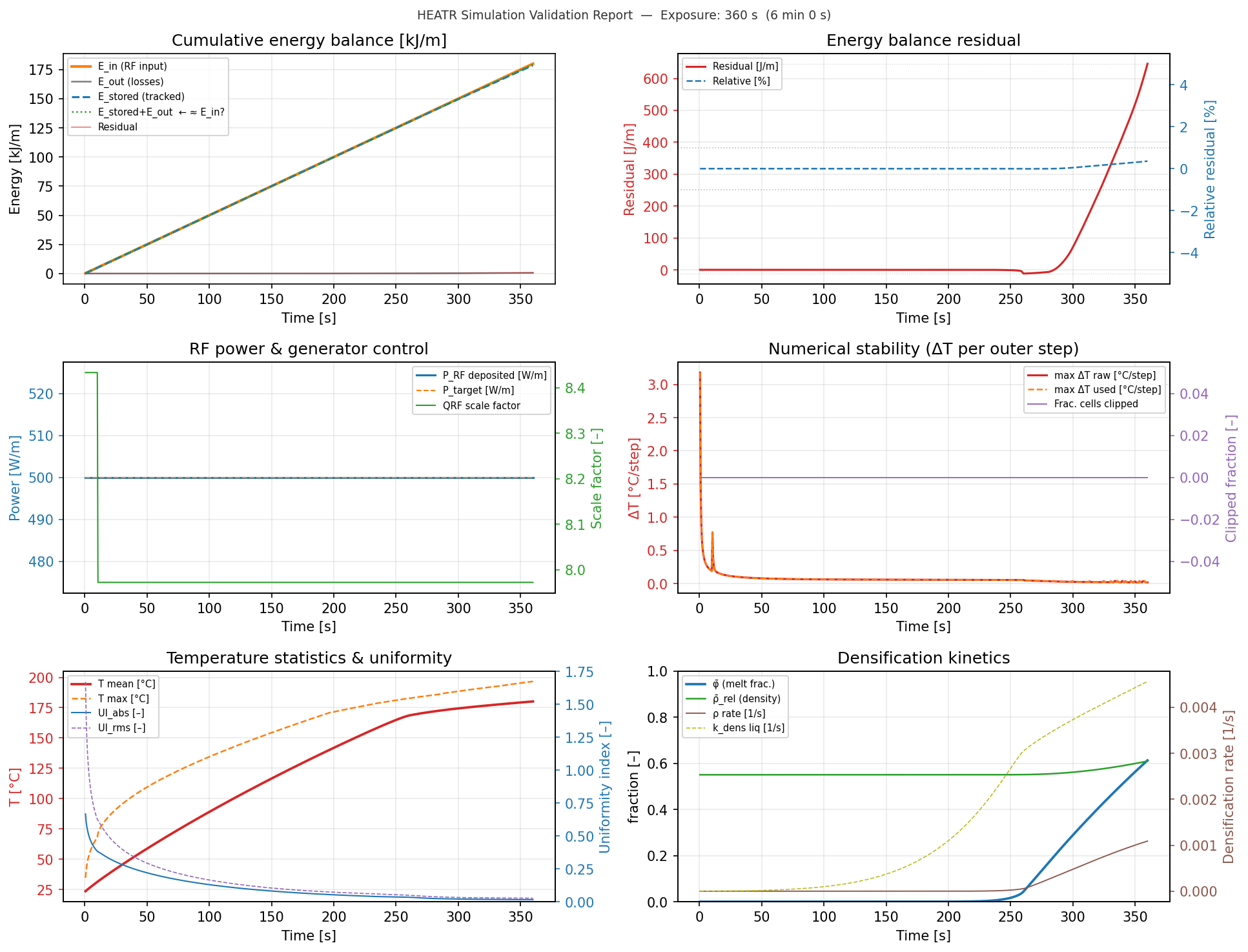 Validation: Energy & Solver Diagnostics
HEATR includes a browser-based GUI for operational control and results exploration. The Operation page provides run configuration (geometry, mode, exposure, turntable parameters), a live job queue with real-time progress tracking, and inline simulation previews. The Results browser offers filterable run history with hero previews, expandable per-run metrics with contextual explanations, and quick access to all output figures. The platform also includes a Files tab for direct output browsing and a Theory tab with integrated physics reference documentation.
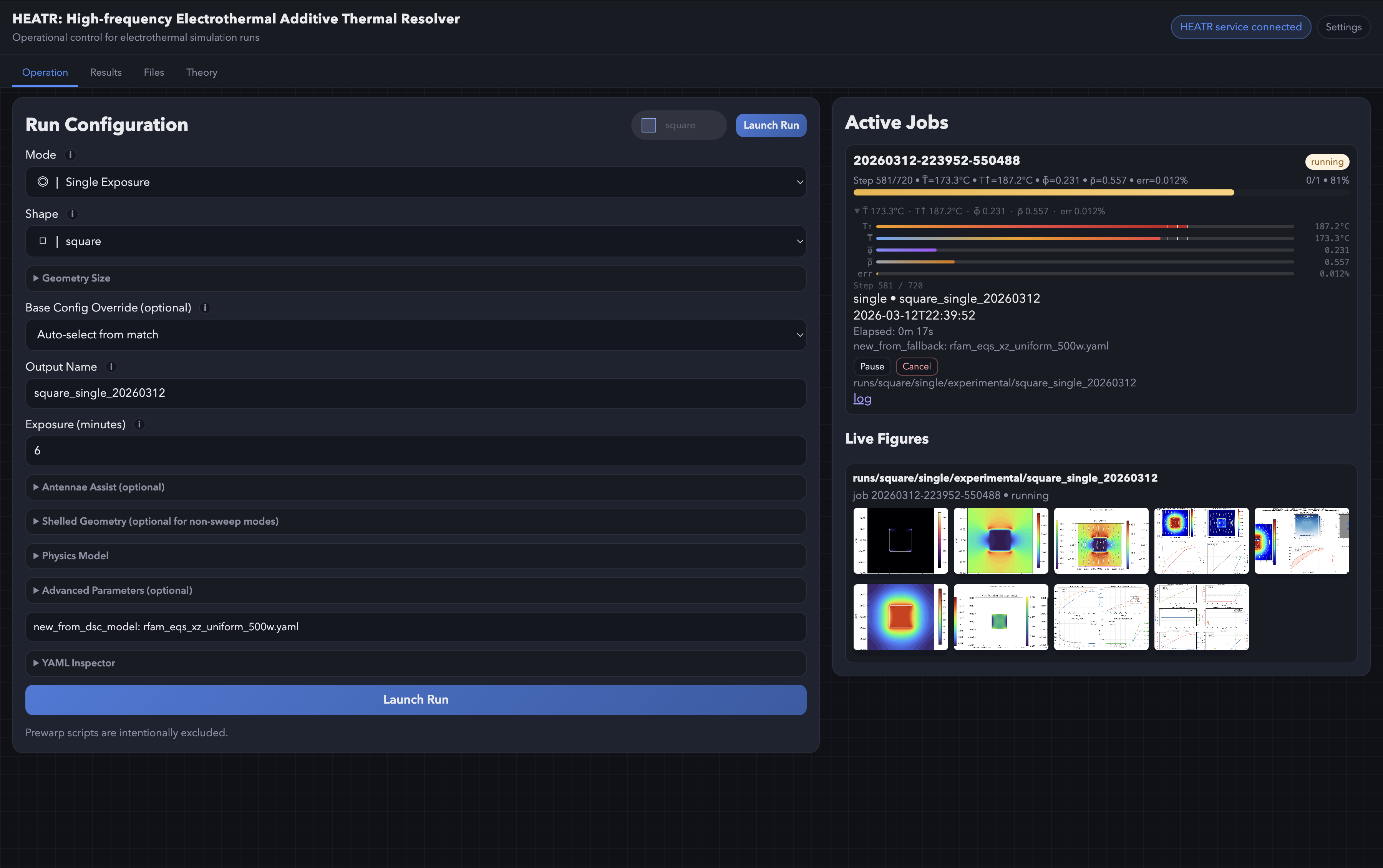 GUI: Operation & Job Queue
 GUI: Results Browser
The clearest way to see what grading does is to print the same hexagon twice. Fill it with ink uniformly and the RF field over-couples at the top and bottom and starves the flanks, so the part melts into an ellipse. Let the solver grade the ink instead, within the eight grey levels the printhead actually has, and the melted region comes out as the hexagon that was asked for. Shape match goes from 76 to 97 percent. Both are simulation.
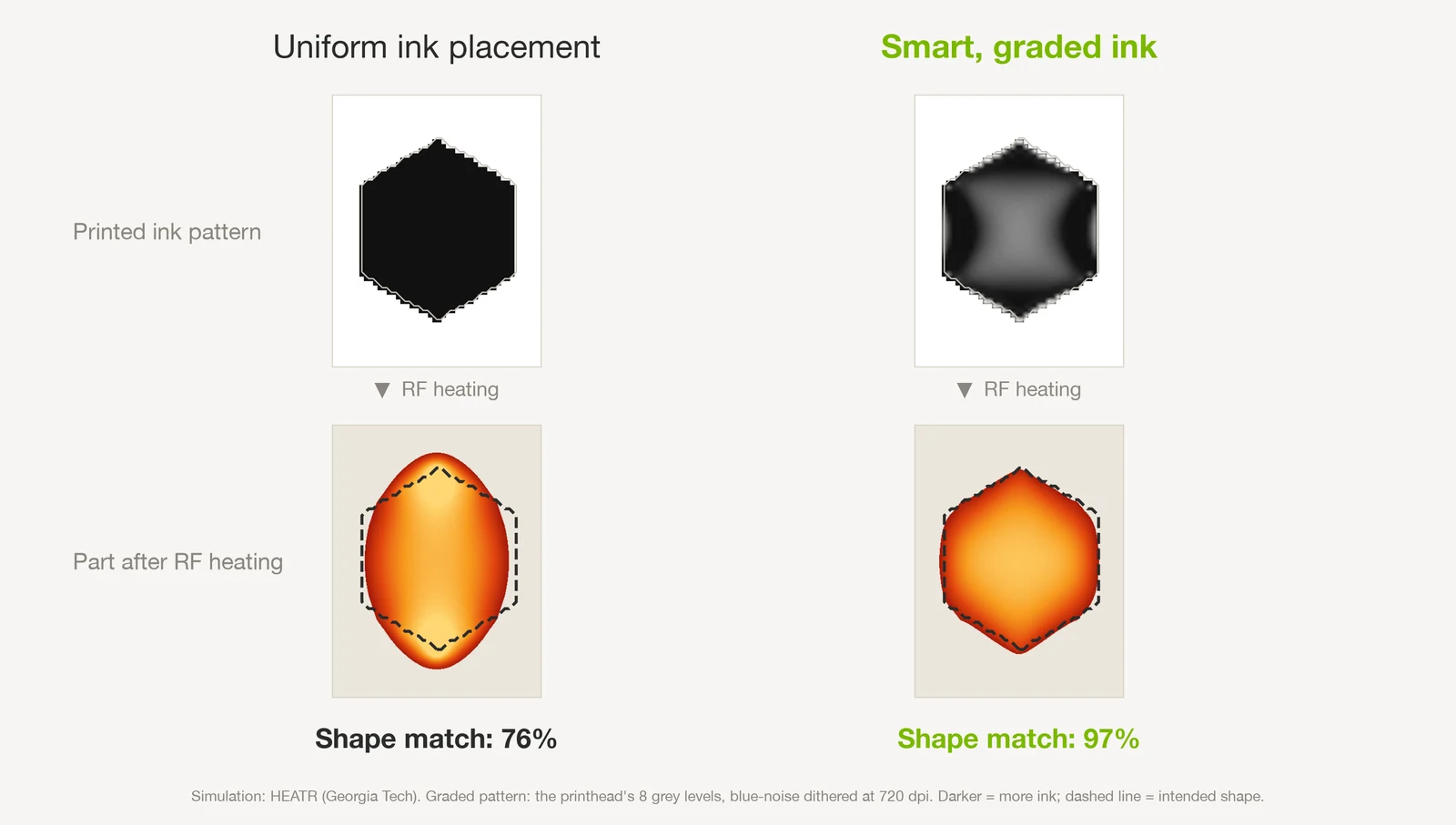 Uniform vs Graded Ink: 76% → 97% Shape Match
A thermal camera only ever sees the top surface. In a volumetric process that is the one place where nothing interesting happens, because the whole point is that the part heats from within. The first instrumented sintering run was a chance to ask what the model says is underneath while the camera watches the top.
Through the run the camera's 24 mm box mean climbed to roughly 100 °C and never approached the 171 °C melt onset. Over the same window the model's core-center band runs to about 330 °C, well past melt. The part then collapsed at 553.7 s and smoked from its center at about 628 s, which is the behaviour of an interior that is far hotter than its surface.
The honest reading matters here. The cube's heating law was fitted to the camera, so the agreement on the top face is partly by construction and is not independent evidence. The core trace is an extrapolation from that fit, and the collapse and the smoke are physical corroboration of it, not a validation of it. The model is not valid after the collapse at 553.7 s, and this run carried no densification and no RF loss in the undoped powder. What the run does establish is that the surface reading alone would have been badly misleading, which is the case for having the forward model at all.
What the camera sees versus what the model says is underneath • 10-20 sintering run • loops automatically
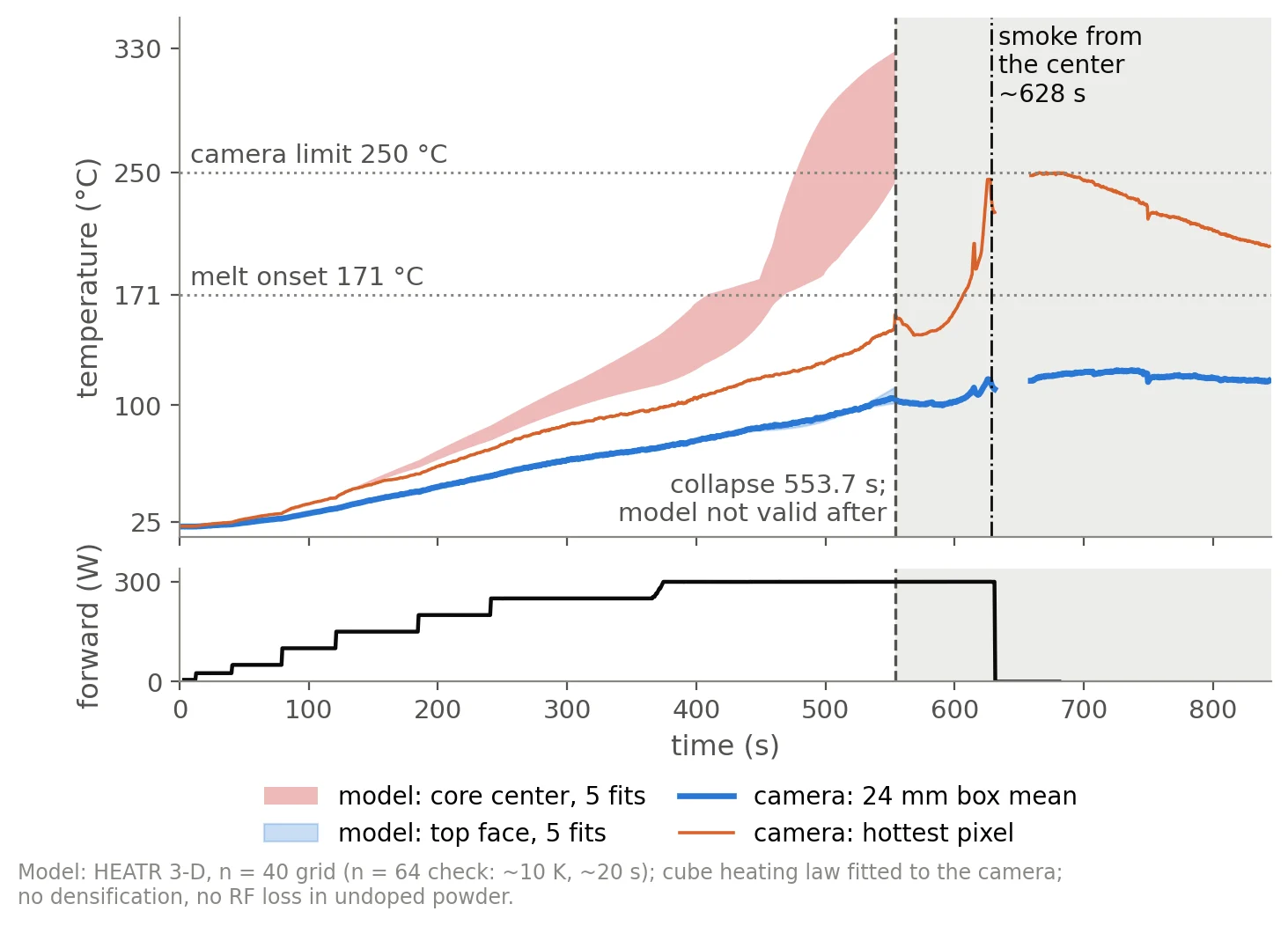 Surface Measurement vs Modelled Interior
Dimensional Metrology of Jetting Fidelity in Binder Jet AM
A low-cost, scanner-based diagnostic pipeline for quantitative dimensional metrology and ink concentration analysis in binder jet additive manufacturing (BJAM). The approach combines high-resolution flatbed scanning (4800–9600 dpi, ~5.3 μm pixel pitch) with open-source Python/OpenCV computer vision to extract feature-specific metrics, producing standardized aggregate and per-instance data products suitable for iterative calibration. The complete toolbox is publicly available as a pip-installable Python package (bjam-toolbox).
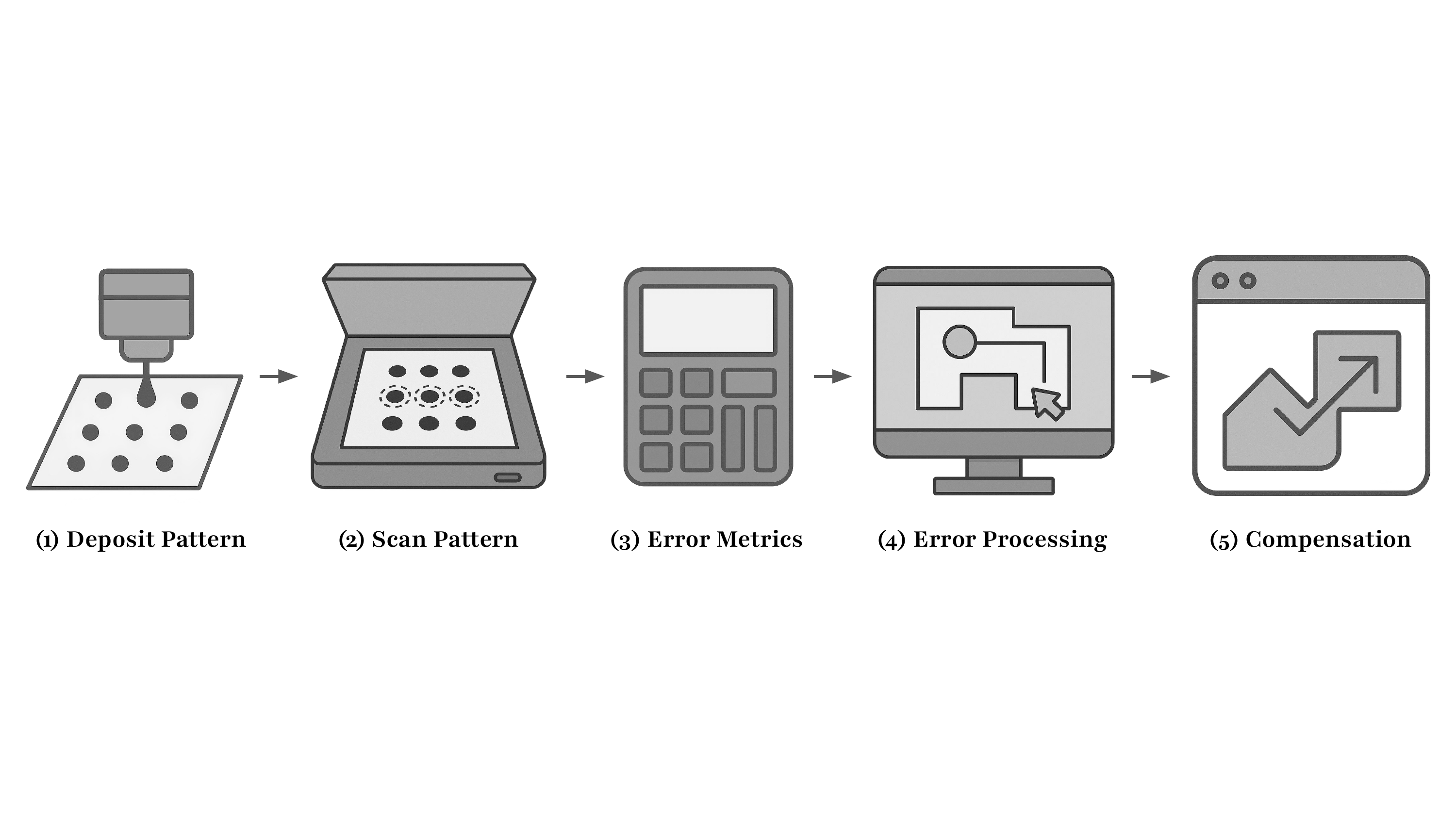 Diagnostic Pipeline Workflow
This tool serves two complementary functions for RFAM process validation:
Calibration patterns are printed on low-wicking substrates to preserve precise droplet locations, then scanned and analyzed to extract geometric error metrics.
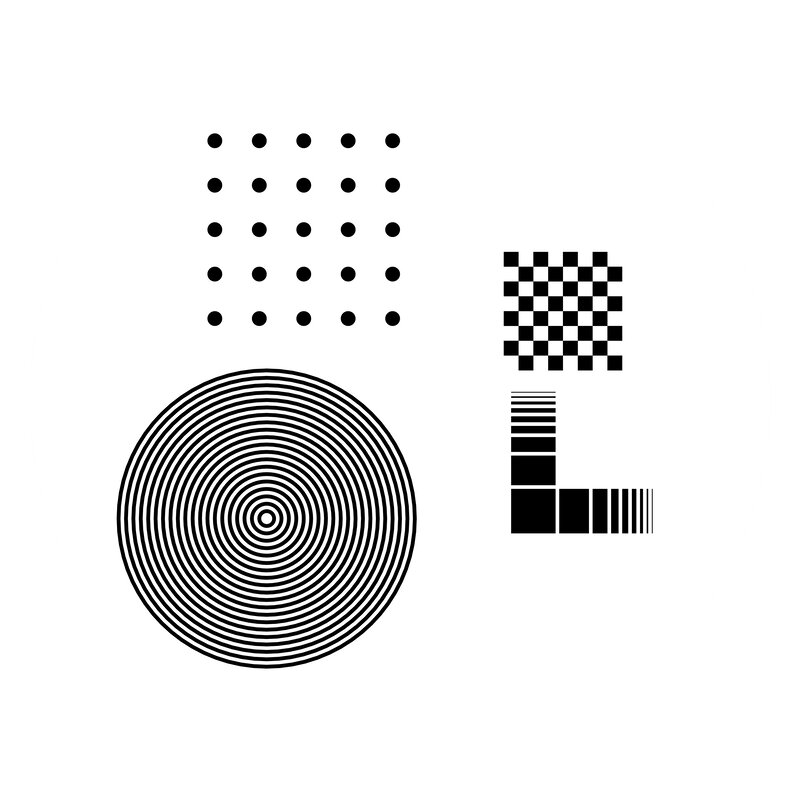 Digital Gold Standard Pattern
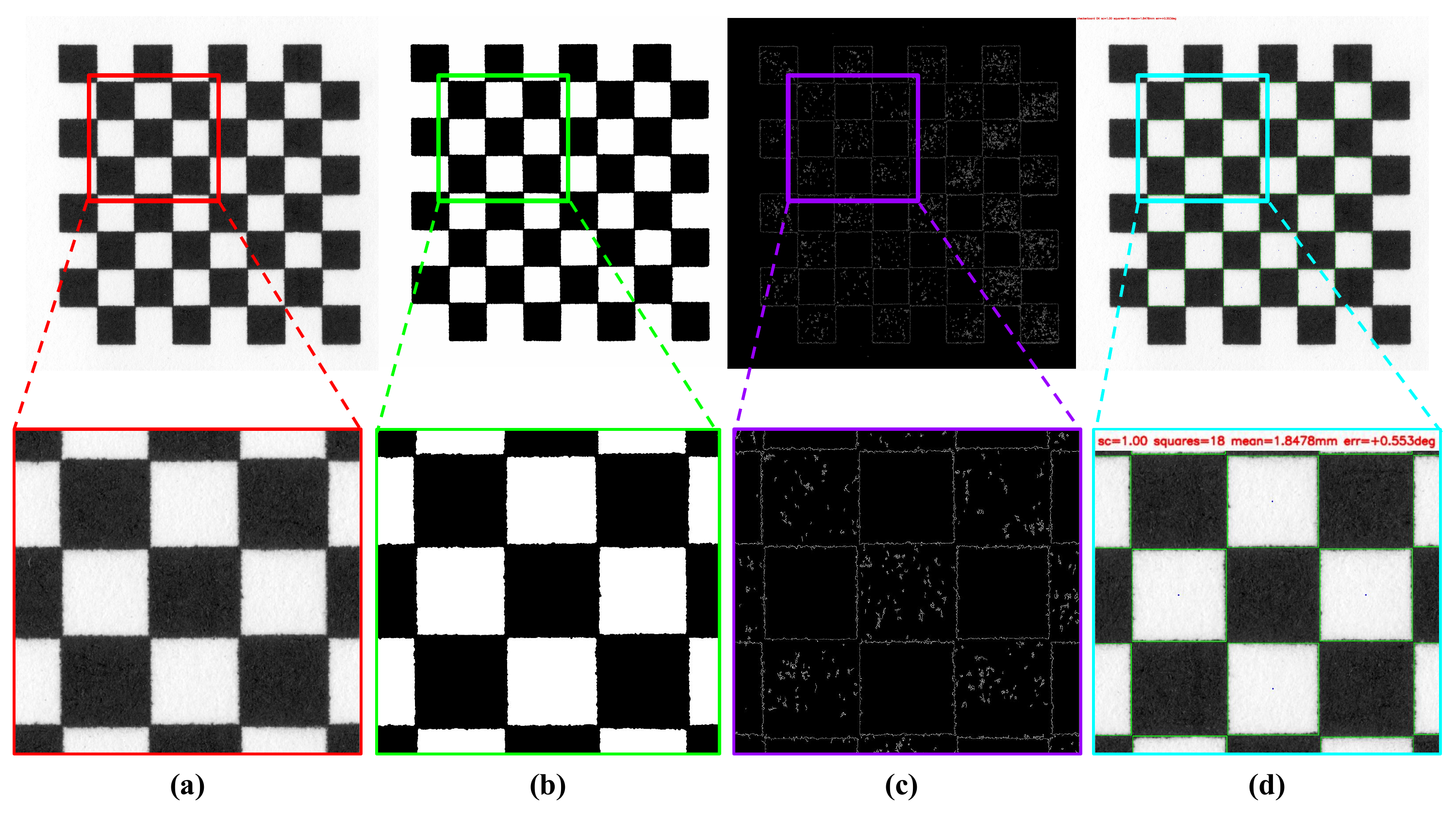 Checkerboard Analysis Pipeline
For dopant concentration analysis, chromatography or blotting paper substrates are used due to their ability to absorb and spread droplets into consistent, analyzable halos. Users interactively select regions of interest using polygon, circle, and ruler tools, then the pipeline segments ink from substrate via Otsu thresholding and extracts a rich metric suite: intensity statistics (mean, std, IQR, skewness, kurtosis, entropy), shape descriptors (circularity, convexity, inertia ratio), and halo eccentricity via morphological erosion and ellipse fitting.
Multiple analysis modes are available for identifying ink type and predicting carbon loading. Deterministic classifiers (weighted score, k-NN, logistic regression) handle material identification and concentration binning, while a Bayesian Gaussian Mixture Model classifier provides posterior probabilities with entropy-based uncertainty quantification. For continuous concentration estimation, Gaussian Process regression with a Matérn 2.5 kernel produces calibrated predictions with confidence intervals, alongside isotonic and k-NN regression baselines. Together these tools verify that the correct dopant concentration is being deposited across the powder bed—critical for achieving uniform RF heating during sintering.
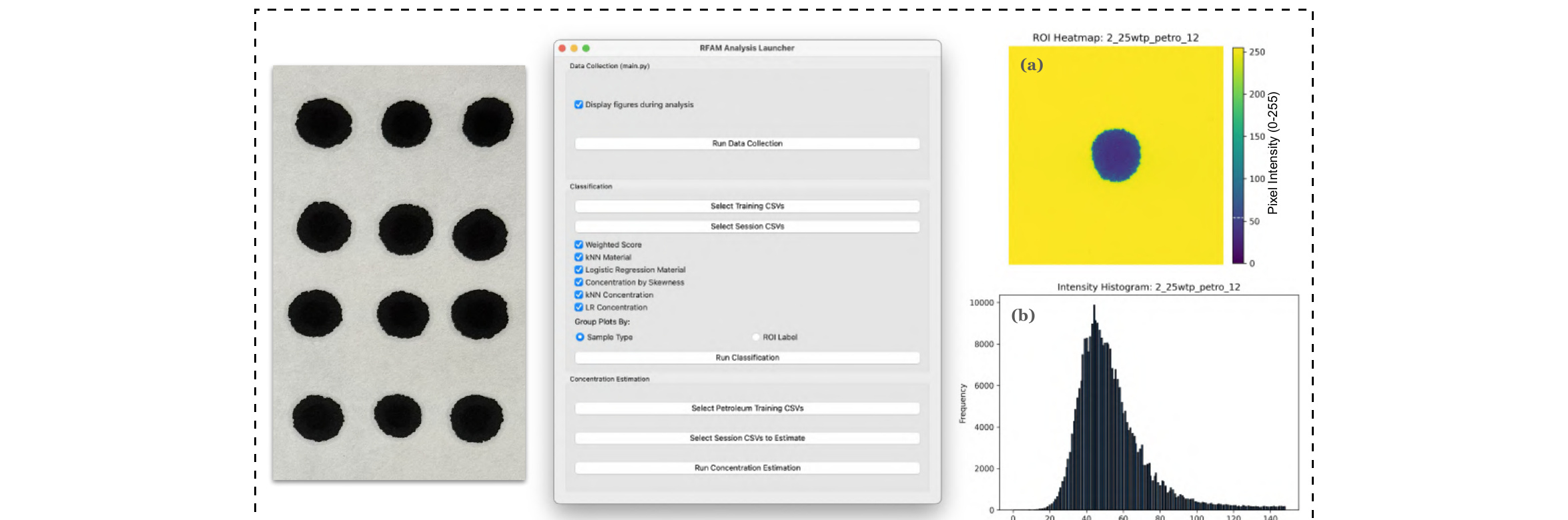 Ink Concentration Analysis Workflow
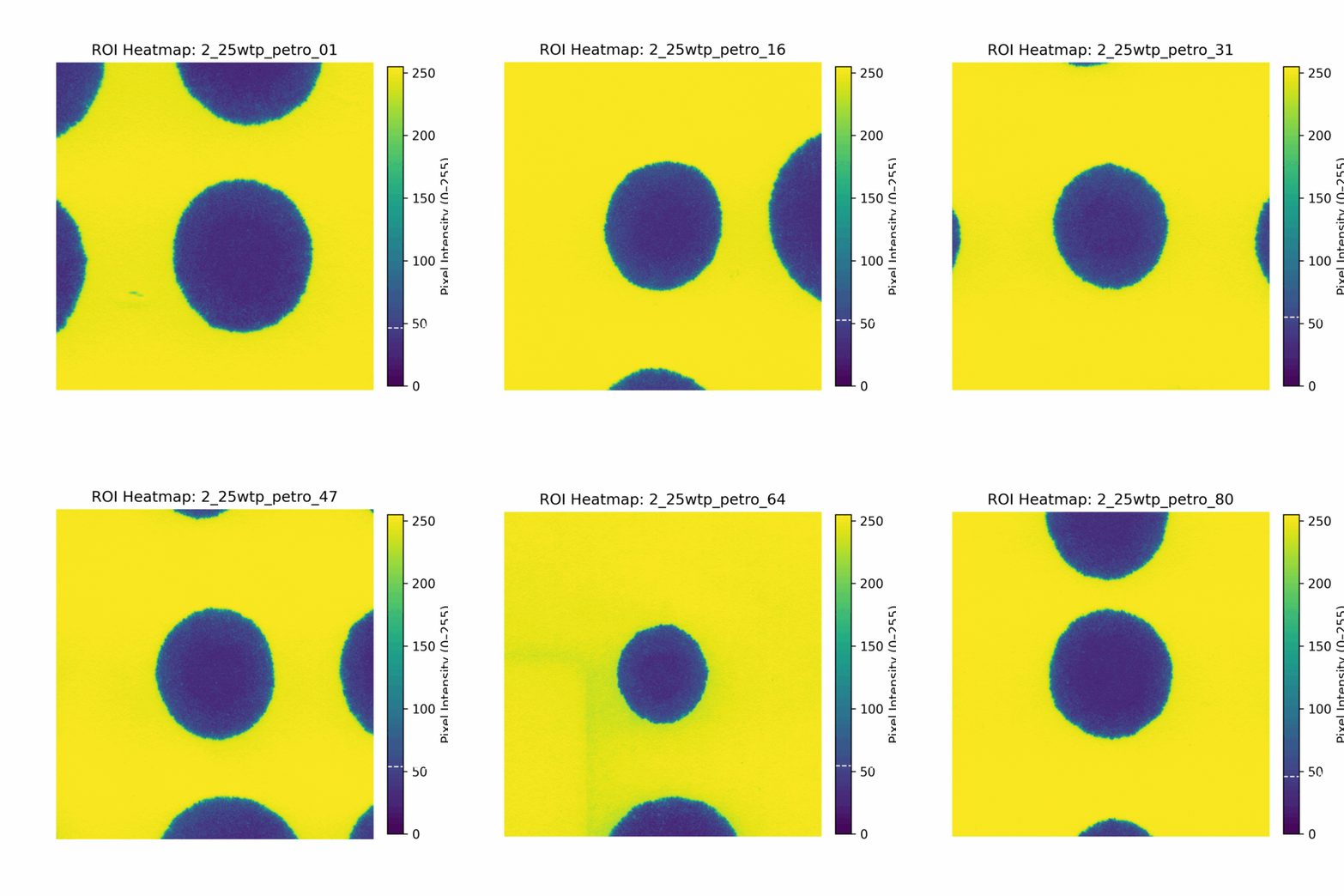 Inkblot Heatmap Analysis
pip install bjam-toolbox) for community use and reproducibilityManuscript in preparation
A Low-Cost Scanner-Based Diagnostic Pipeline for Dimensional Metrology of Jetting Fidelity in Binder Jet Additive Manufacturing
Manuscript in preparation
On the Role of Interface Strategy in Multi-Scale Hybrid Additive Manufacturing
npj Advanced Manufacturing 2, 38 (2025)
doi.org/10.1038/s44334-025-00034-zMachine Design and Process Development of Volumetric Polymer Powder Bed Fusion by Radio Frequency Additive Manufacturing
Solid Freeform Fabrication Symposium, Austin, TX (2024)
Radio Frequency Additive Manufacturing (RFAM): A Roadmap to Precision Parts via Platform Design and Low-Cost Jetting Diagnostics
Solid Freeform Fabrication Symposium, Austin, TX (2025)
Geometry-Dependent Sintering Nonuniformity in Radio Frequency Additive Manufacturing
Solid Freeform Fabrication Symposium, Austin, TX (2026)
Impact of Heat Input and Step Over Distance on Part Geometry for Multi-Bead WAAM Components
ASME MSEC 2024, Knoxville, TN
doi.org/10.1115/MSEC2024-122007
2020
Sometimes the best engineering projects are the ones that solve problems nobody asked to be solved. This ridiculously over-engineered automatic bottle opener was built with friends during college—and ended up getting featured on Hackaday's website and podcast.
*Listed as #99 because Hackaday uses zero-indexed episode numbering
Interactive Environments • Fall 2024
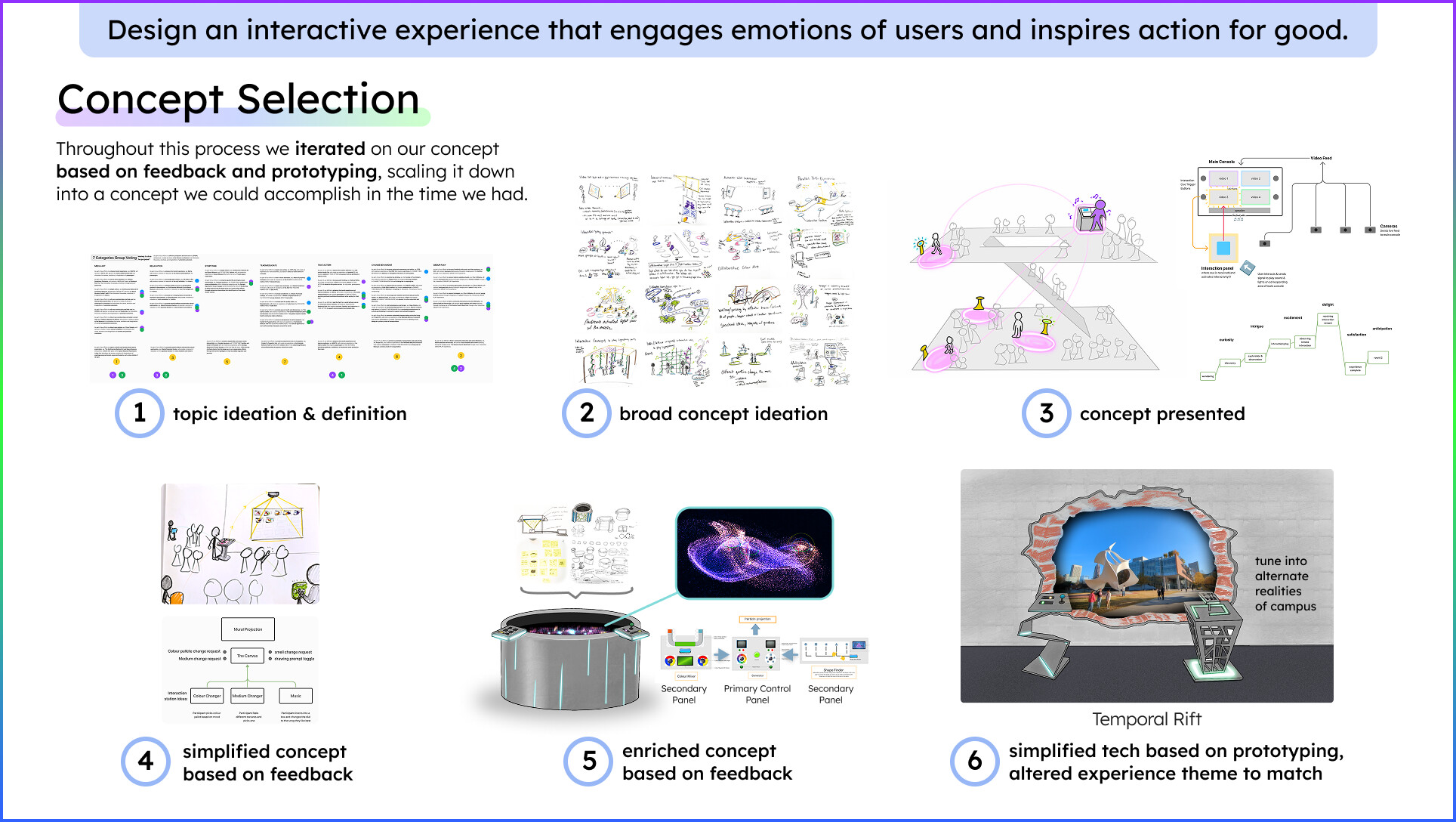
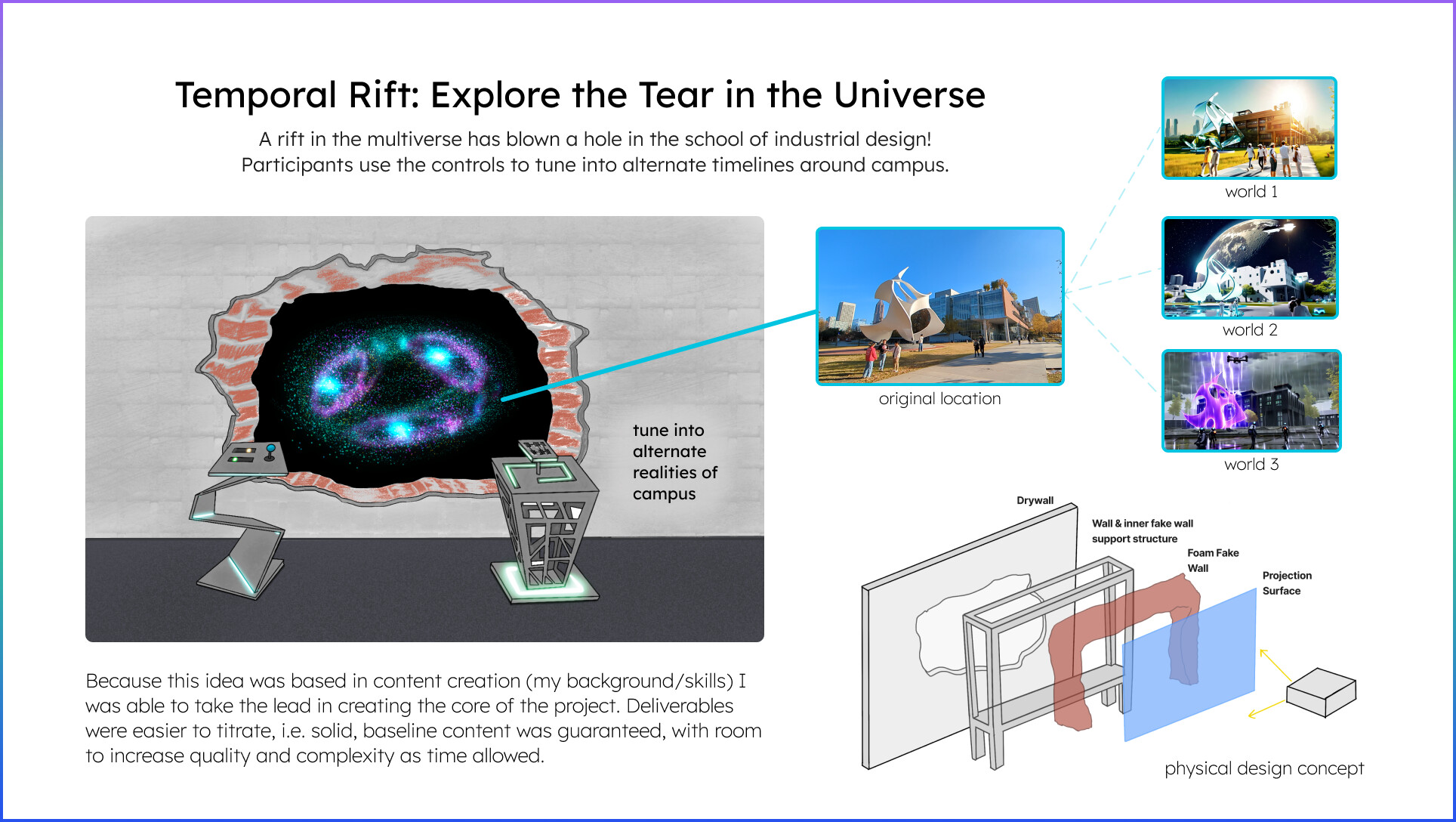
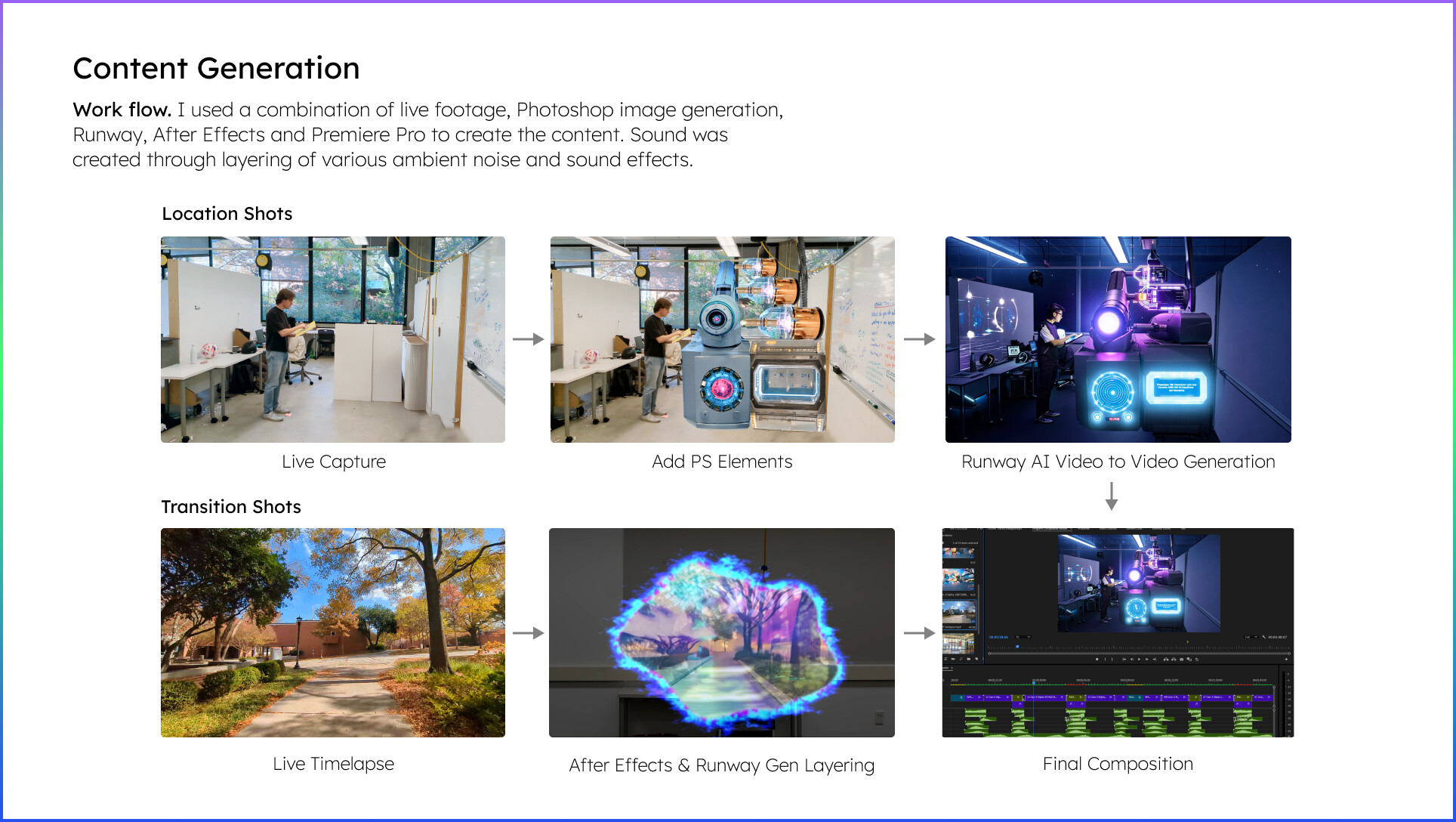
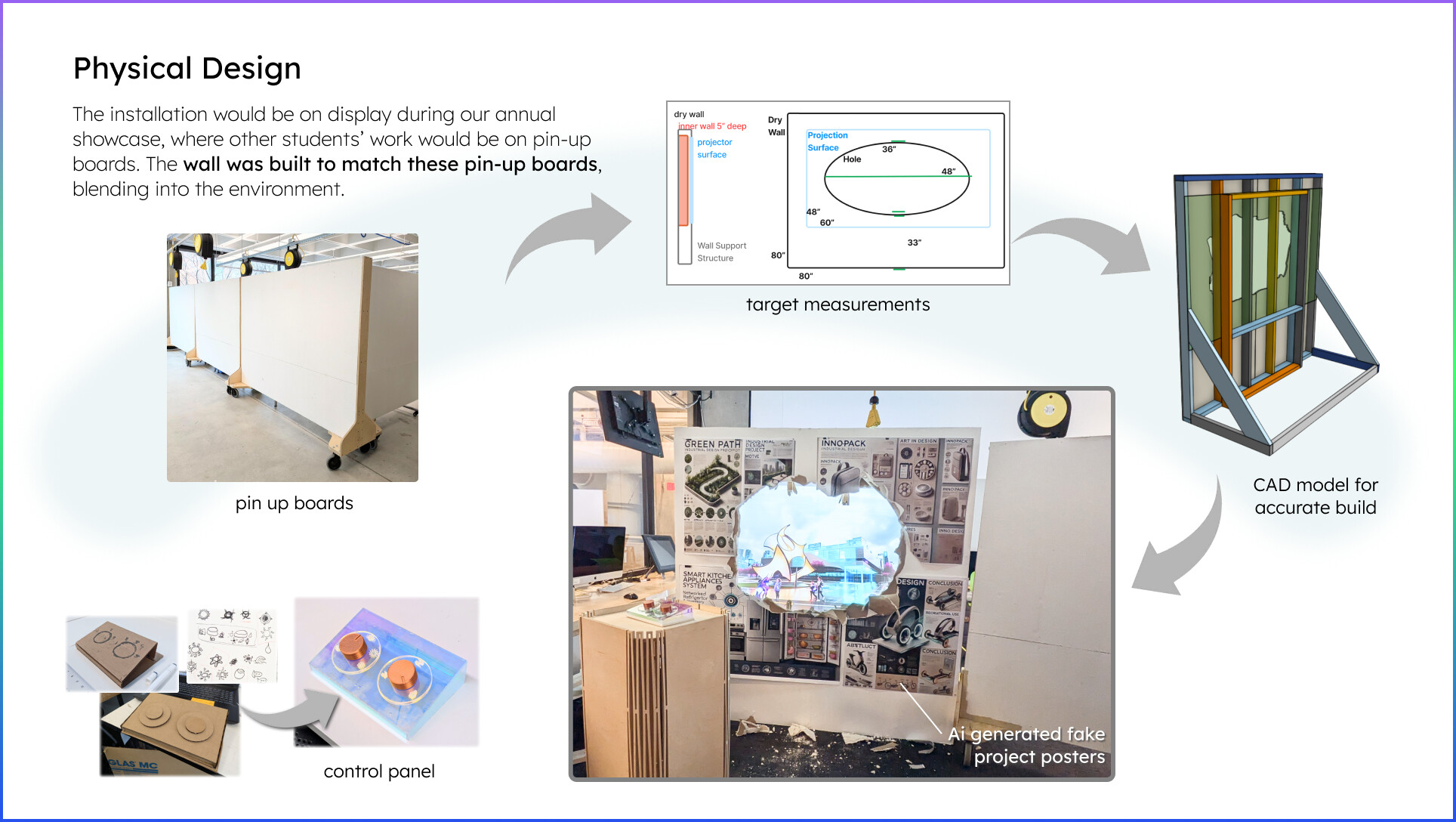
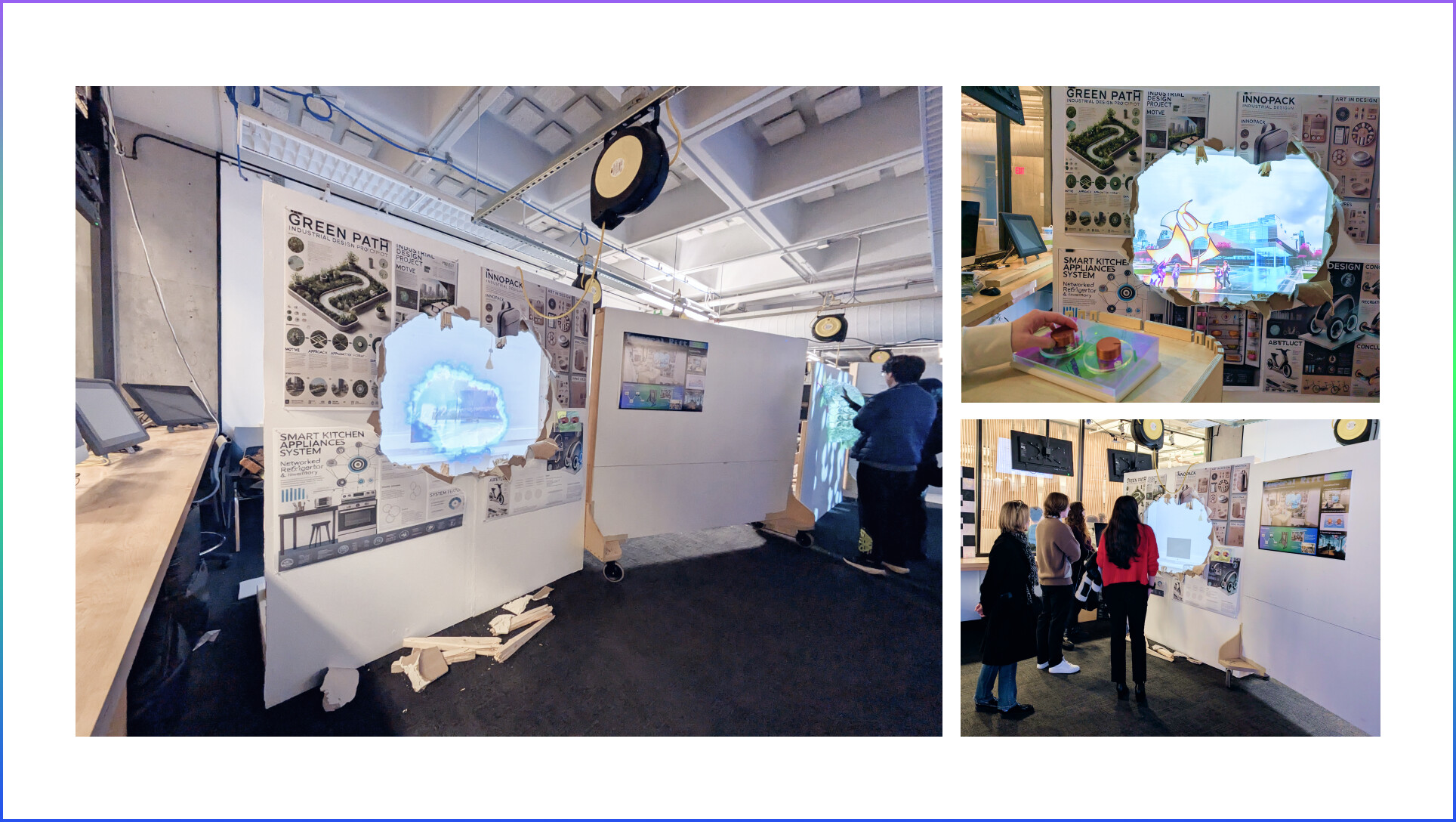
Temporal Rift is an interactive installation created for Georgia Tech's biannual student showcase. Guests could peer through an interdimensional portal to view alternate realities of the Georgia Tech campus, using physical controls to navigate between worlds and locations.
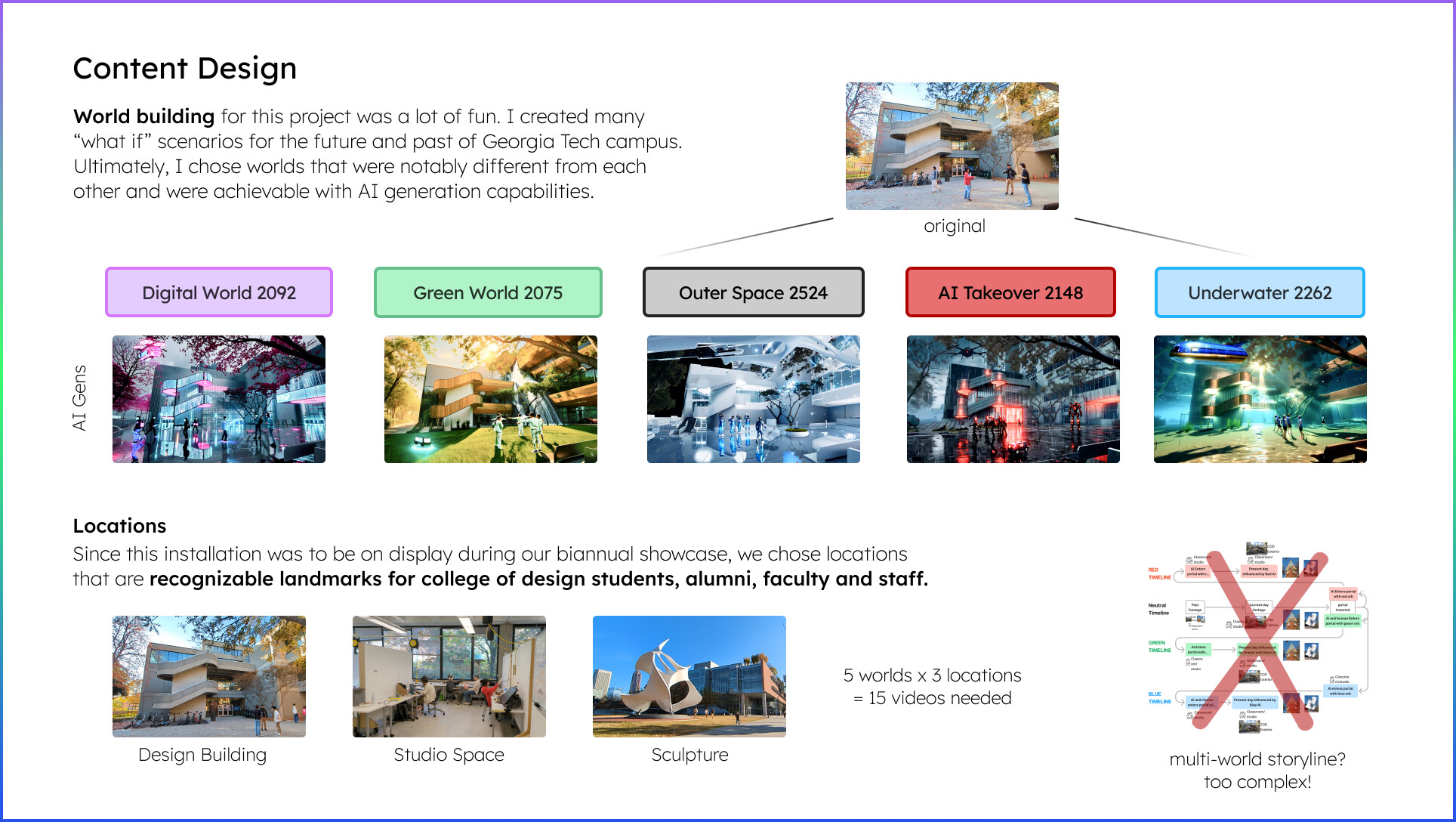
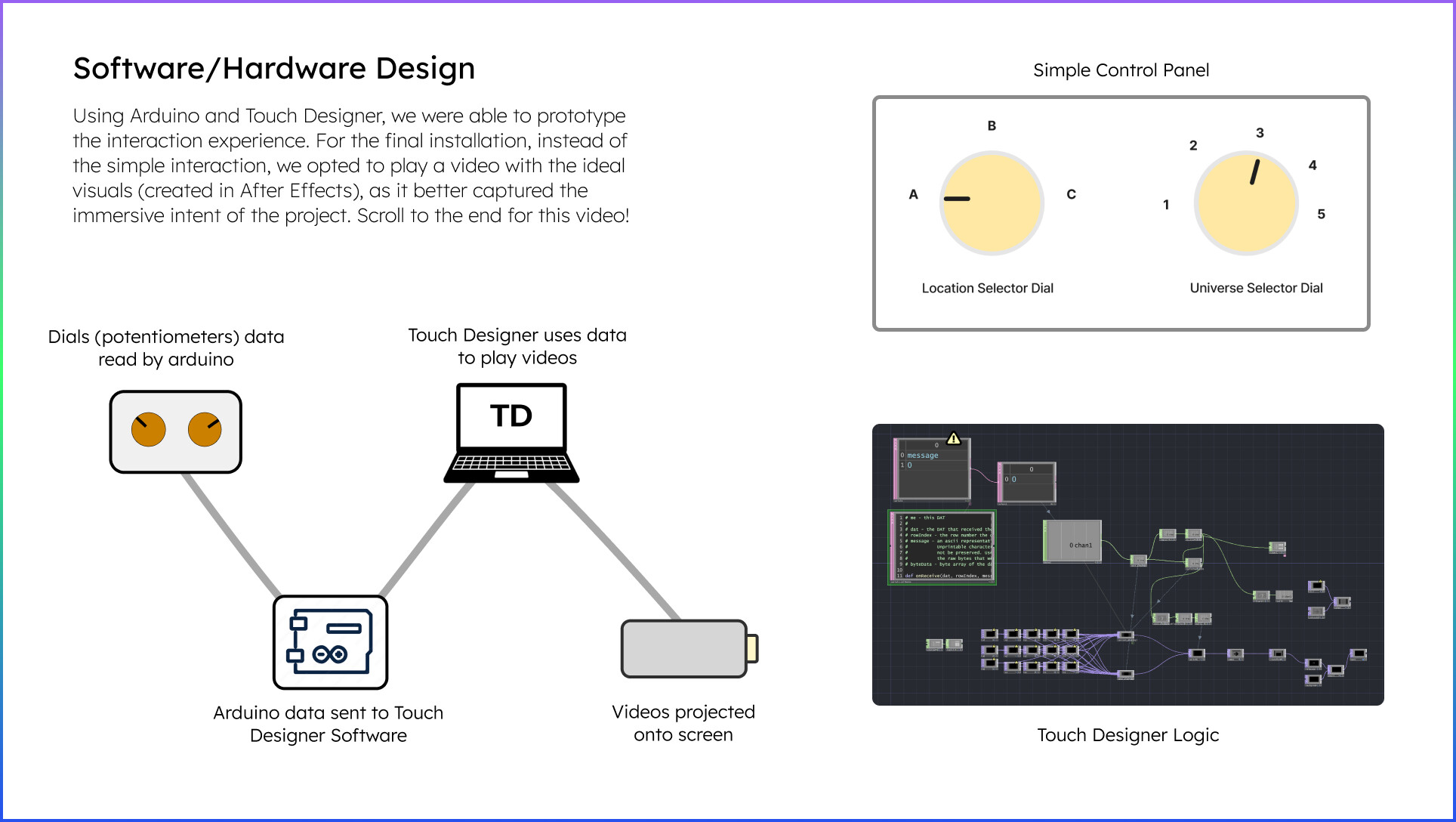
The installation simulates an interdimensional portal that has "ripped" through a wall, revealing glimpses of alternate futures. Guests can use two physical dials to control the experience: one selects the alternate world, and one selects the campus location they're viewing. Five distinct worlds were created, each with three campus locations (15 total scenes):
 Installation Overview
 Control Panel
 Portal Frame
 World Selection
 Guest Interaction
 Alternate Reality
 Physical Installation
 Exhibition Setup
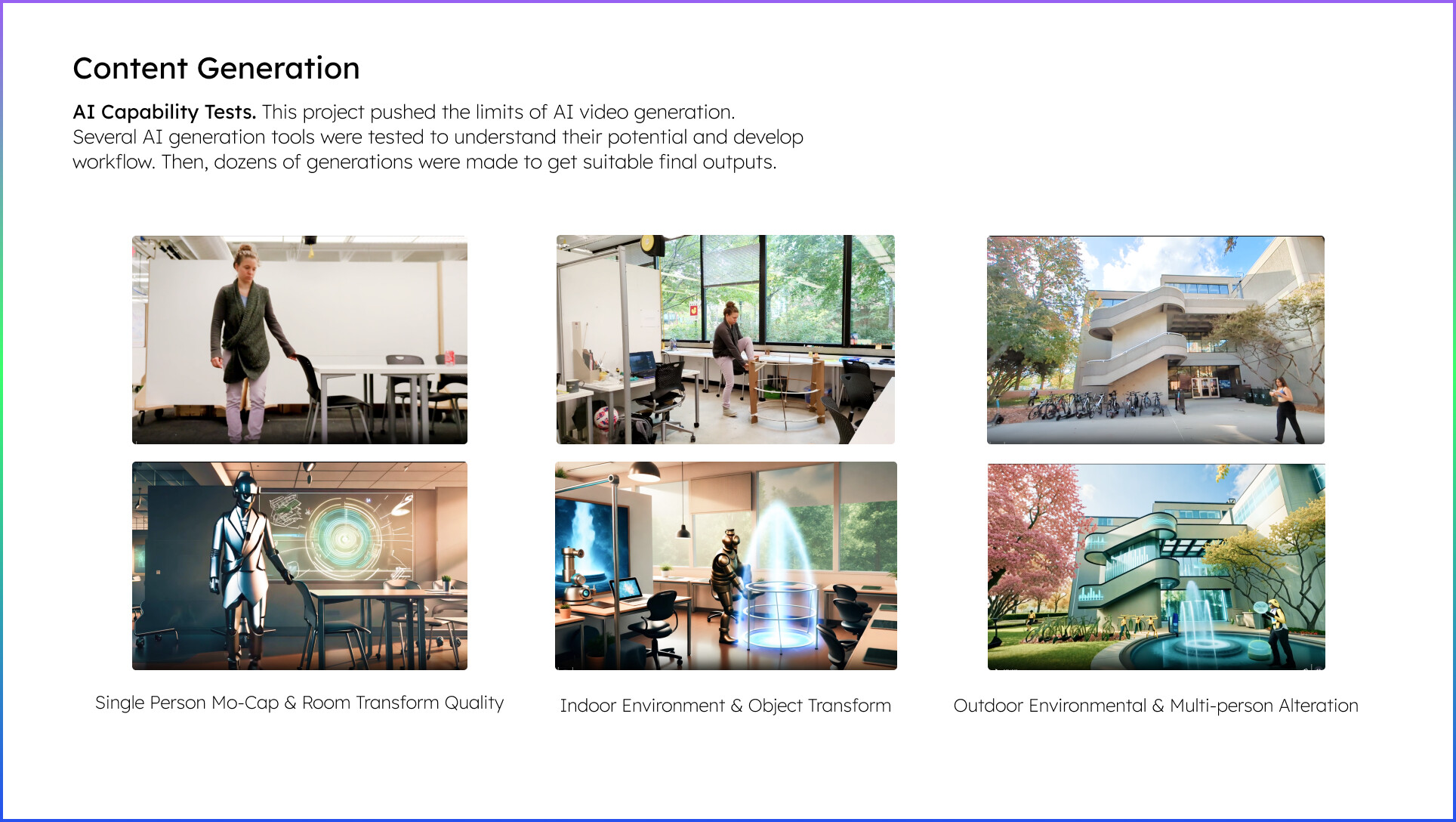
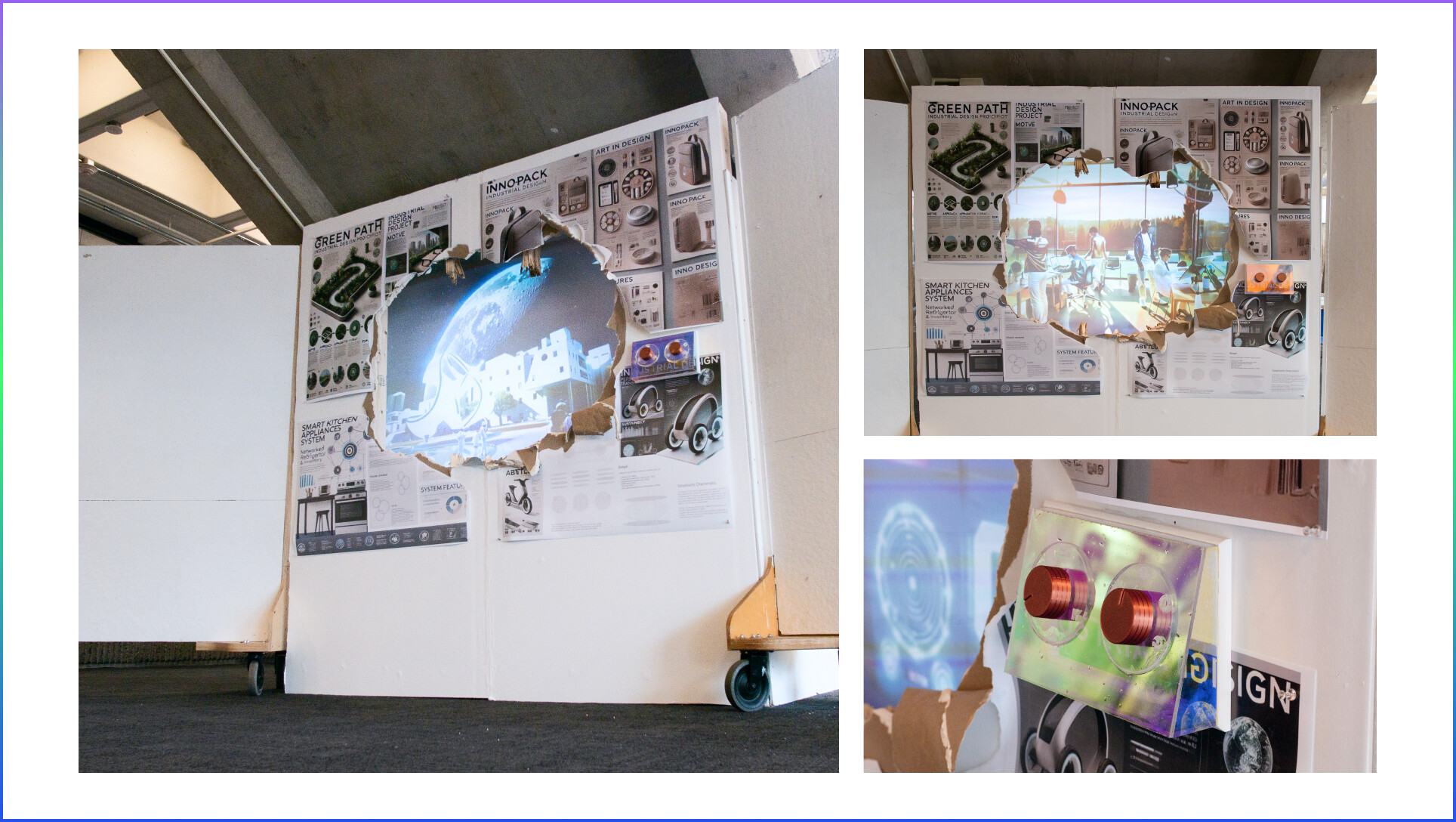 AI-Generated Content
 Final Exhibition
Jojo Brauer
Service Design, Brand & Marketing • Fall 2025
Orbit is a mobile app designed to help seniors plan weekly activities that keep them physically active, mobile, and socially connected. Developed through user research with elderly community members and healthcare workers, the app addresses the growing need for tools that support healthy aging while respecting independence and autonomy.
As populations age globally, many seniors face challenges staying physically and socially active. Research shows that maintaining regular activity is crucial for both physical health and mental wellbeing, yet many older adults struggle to find and plan appropriate activities that match their preferences, abilities, and social needs.
Click through the app to experience the onboarding flow and main features.
Victoria Gamez (MID), Michelle Kim (MID), Matt McCoy (ME PhD)
10+ Years of Performance & Study
I studied Jazz Saxophone Performance at Northern Illinois University, playing lead alto in the NIU Jazz Orchestra and Ensemble under the direction of Geof Bradfield, Reggie Thomas, and Rich Moore.
Music taught me to listen deeply, collaborate effectively, and think on my feet—skills that translate directly to engineering leadership and research.
Geof Bradfield, Reggie Thomas, Rich Moore
